Most drivers don’t think about spark plugs until their car sputters, stalls, or refuses to start. But spark plugs are one of the most critical parts in your engine-and they don’t last forever. So how many years do spark plugs last? The answer isn’t simple. It depends on the type, your driving habits, and your car’s engine design. Some spark plugs can last over 10 years. Others need replacing after just 30,000 miles. Let’s cut through the noise and give you real numbers, real advice, and real signs you’re overdue.
What Spark Plugs Actually Do
Spark plugs create the tiny electric spark that ignites the fuel-air mixture in your engine’s cylinders. Without that spark, your engine doesn’t run. They sit right in the combustion chamber, exposed to extreme heat, pressure, and chemical buildup. Over time, the electrodes wear down, the gap widens, and carbon or oil deposits coat the tip. That’s when performance drops.
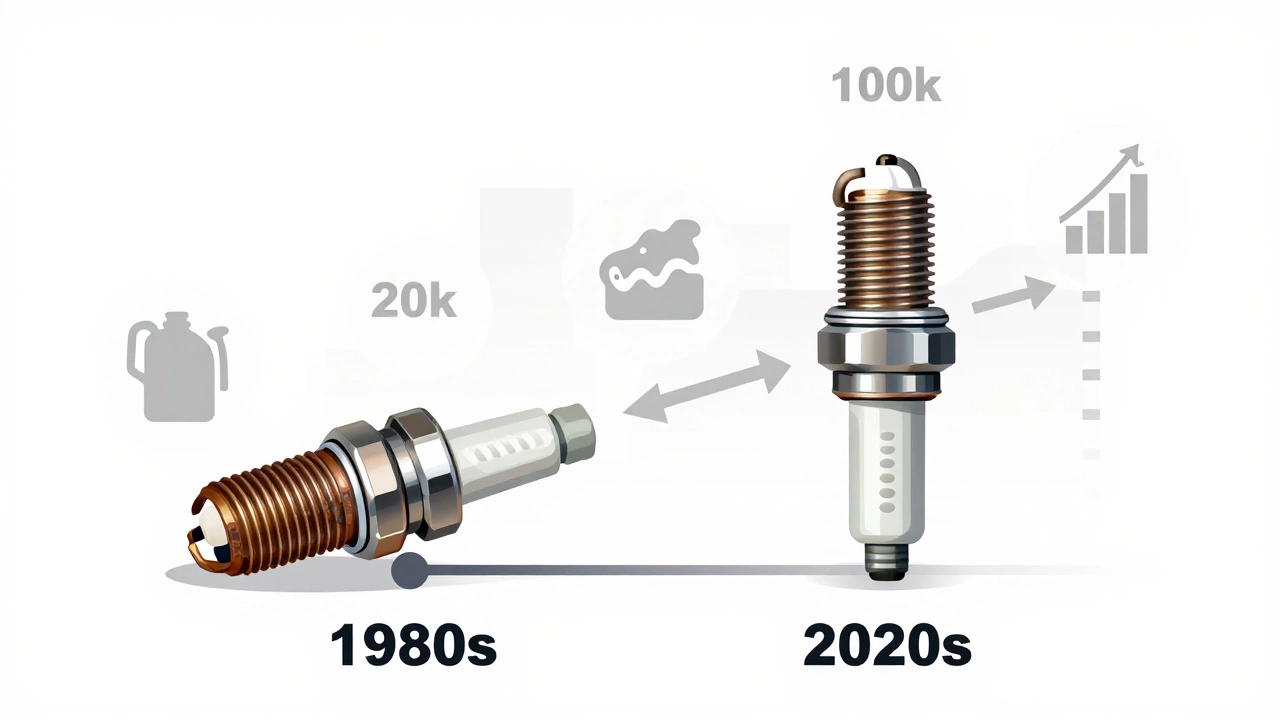
Modern spark plugs aren’t like the old ones from the 1980s. Back then, copper plugs needed replacing every 12,000 to 20,000 miles. Today’s engines are more efficient, and materials have improved dramatically. But that doesn’t mean you can ignore them.
How Long Spark Plugs Last by Type
Not all spark plugs are made the same. The material used for the center electrode determines how long they last. Here’s what you’re likely to find in your car today:
- Copper spark plugs: These are the oldest and cheapest type. They last about 20,000 to 30,000 miles, or roughly 1.5 to 2 years for average drivers. They’re common in older cars and some budget models. They conduct heat well but wear out fast.
- Platinum spark plugs: These last longer-typically 60,000 to 100,000 miles. That’s about 4 to 7 years. The platinum tip resists erosion better than copper, so the gap stays tight longer. Many cars from the 2000s to early 2010s came with these.
- Double platinum: These have platinum on both the center and ground electrodes. They’re designed for waste spark ignition systems (common in V6 and V8 engines). Lifespan: 80,000 to 100,000 miles, or 5 to 7 years.
- Iridium spark plugs: The current gold standard. Iridium is harder and more heat-resistant than platinum. These last 90,000 to 120,000 miles, which for most people means 7 to 10 years. Most new cars (2015 and newer) come factory-equipped with iridium plugs.
Manufacturers often install iridium plugs because they’re designed to last the life of the engine. But that doesn’t mean they’ll never need replacement. Real-world conditions change everything.
What Shortens Spark Plug Life
Even the best spark plugs can fail early if your car has other problems. Here are the top three killers:
- Oil leaks: If your valve cover gasket or piston rings are leaking oil, it coats the spark plug tip. That creates a conductive film that prevents the spark from jumping the gap. Result? Misfires, rough idle, poor fuel economy. You’ll need to fix the leak AND replace the plugs.
- Rich fuel mixture: If your fuel injector is dripping or your air filter is clogged, too much fuel enters the combustion chamber. That leads to carbon buildup on the plug. Black, sooty plugs mean your engine isn’t burning fuel cleanly. This isn’t a plug problem-it’s a system problem.
- Short trips and cold starts: If you only drive 5 miles to work and back every day, your engine never reaches full operating temperature. That means moisture and unburned fuel don’t evaporate. They turn into gunk on the plugs. City drivers often need plug replacements sooner than highway drivers.
One study from the Society of Automotive Engineers found that drivers who average less than 5,000 miles per year saw 30% more plug fouling than those who drove 15,000+ miles annually-even with the same plug type.

Signs Your Spark Plugs Are Failing
You don’t need a diagnostic tool to know when your plugs are dying. Here are the real-world signs:
- Engine misfires: You feel a jerk or stumble when accelerating. Sometimes the check engine light flashes.
- Hard starting: The engine turns over but takes longer than usual to fire up-especially in cold weather.
- Reduced fuel economy: You’re filling up more often, and your mileage has dropped by 10% or more without any other changes.
- Slow acceleration: The car feels sluggish, like it’s dragging. No power when you press the gas.
- Engine rattle or knocking: That metallic ping under load? That’s pre-ignition, often caused by worn plugs and hot spots in the cylinder.
If you notice two or more of these, don’t wait for the car to break down. Pull the plugs and inspect them. A mechanic can do it in 30 minutes. You can do it yourself with a socket and a torque wrench.
When to Replace Spark Plugs: The Real Rule
Most car manuals say “replace at 100,000 miles.” But that’s a maximum, not a recommendation. Here’s the smarter approach:
- If your car is under 10 years old and you drive normally: Wait for the manufacturer’s interval (usually 60,000-100,000 miles).
- If your car is over 10 years old: Replace them at 60,000 miles, even if the manual says longer. Older engines are more sensitive to plug wear.
- If you drive mostly short trips or in stop-and-go traffic: Replace at 50,000 miles.
- If you’ve had engine trouble (oil leaks, misfires, rich codes): Replace plugs immediately-even if they’re not due.
Don’t let the “100,000-mile” claim fool you. That number assumes perfect conditions: clean fuel, no leaks, consistent driving, and no engine stress. Real life doesn’t work that way.
What Happens If You Don’t Replace Them
Ignoring worn spark plugs doesn’t just hurt performance-it can cost you big money.
When plugs misfire, unburned fuel floods into the exhaust system. That overheats the catalytic converter. Replacing one of those costs $1,000 to $2,500. That’s more than 10 sets of spark plugs.
Worn plugs also force your engine to work harder. That means more strain on the ignition coils. A bad coil costs $200-$400 to replace. And if the misfire continues long enough, it can damage the valves or even the piston rings.
One mechanic in Ohio told me he’s seen three cars in the last year where owners ignored spark plug warnings for 20,000 miles past the limit. All three needed catalytic converters replaced. One needed a full engine rebuild.
Can You Extend Spark Plug Life?
You can’t make them last longer than their material allows. But you can help them last as long as they should:
- Use quality fuel. Cheap gas has more impurities that lead to carbon buildup.
- Change your air filter regularly. A dirty filter restricts airflow and makes the engine run rich.
- Fix oil leaks fast. Even a small leak can ruin plugs in months.
- Take longer drives occasionally. A 30-minute highway trip every few weeks burns off deposits.
- Use the correct plug type. Never swap in a cheaper plug just to save money. Your engine was designed for a specific heat range and gap.
And never, ever use “lifetime” spark plugs unless your manual specifically says so. That’s a marketing term, not a guarantee.
How Much Do Spark Plugs Cost to Replace?
Parts cost varies by type:
- Copper: $1-$3 each
- Platinum: $5-$10 each
- Iridium: $8-$15 each
A typical 4-cylinder car needs 4 plugs. A V6 needs 6. A V8 needs 8. So parts alone might run $20 to $120.
Labor is usually $80 to $150, depending on engine access. Some engines (like BMWs or Subarus) require removing the intake manifold to reach the plugs. That pushes labor to $300+.
But if you’re handy, you can do it yourself in under an hour with basic tools. Just make sure to use a torque wrench. Overtightening cracks the plug. Under-tightening causes leaks. Follow your manual’s spec-usually 15-20 ft-lbs.
Final Answer: How Many Years Do Spark Plugs Last?
On average, spark plugs last between 3 and 10 years. But here’s the truth:
- If you have an older car with copper plugs: Replace them every 2 years.
- If you drive a mid-2000s to early 2010s car with platinum: Replace them every 5 years.
- If you drive a 2015 or newer car with iridium: You can go 7 to 10 years-but only if your engine is healthy.
But don’t just count the years. Count the miles. And listen to your car. If it’s misfiring, struggling to start, or burning more fuel, don’t wait for the manual. Replace the plugs. It’s cheap insurance against a much bigger repair.
Spark plugs are small. But they’re the spark that keeps your engine alive. Treat them like the critical component they are.
Can spark plugs last 200,000 miles?
It’s extremely rare. Even the best iridium plugs are rated for up to 120,000 miles. Some drivers claim longer life, but that’s usually because their engine is running too lean, or they’re not driving hard enough to stress the plugs. In real-world conditions, pushing past 120,000 miles risks misfires, poor fuel economy, and damage to the catalytic converter.
Do spark plugs go bad if the car isn’t driven?
Yes. If a car sits for months without being started, moisture builds up inside the cylinders. That can cause corrosion on the plug electrodes. Fuel also breaks down over time, leaving varnish deposits. If your car has been idle for over 6 months, inspect or replace the plugs before driving it again.
Should I replace all spark plugs at once?
Always. Even if only one plug is bad, the others are likely close to failing. Mixing old and new plugs creates uneven performance. Your engine runs best when all cylinders fire with the same strength. Replacing them as a set ensures smooth operation.
Can I clean spark plugs instead of replacing them?
You can clean fouled plugs with a wire brush or sandblaster, but it’s not recommended. Cleaning doesn’t restore the electrode gap or fix wear. Even if it looks clean, the gap may be too wide, or the ceramic insulator may be cracked. New plugs cost less than the time and risk of cleaning. Replace them.
Do spark plugs affect gas mileage?
Absolutely. Worn or fouled spark plugs can reduce fuel economy by 10% to 30%. That’s like paying $1 to $3 extra per gallon. If you’re getting 25 mpg and your plugs are bad, you could be getting 18 mpg without realizing why. Replacing them often pays for itself in fuel savings within one tank.