Exhaust Sizing Calculator for 200 HP Engines
Configure Your Engine
Recommendation
Select options and click calculate to see results.
Physics Analysis
You just swapped in a turbo kit or rebuilt your engine to hit the 200 hp mark. It runs great, but something feels off. Maybe it’s sluggish at high RPMs, or maybe you’re hearing that annoying drone that makes conversations impossible on the motorway. The culprit is almost always the wrong exhaust system. Getting the pipe diameter right isn’t just about looking aggressive under the bumper; it’s about physics. If the pipes are too small, you choke the engine. Too big, and you lose low-end torque. So, what size exhaust do you actually need for 200 horsepower?
The short answer? For most naturally aspirated engines producing around 200 hp, a 2.5-inch (63mm) exhaust system is the sweet spot. However, this changes if you have a turbocharged setup, a diesel, or a specific engine configuration like a V6 versus an inline-4. This guide breaks down exactly how to calculate the right flow rate, why "bigger is better" is a myth, and how to avoid the common pitfalls that ruin performance.
The Physics of Exhaust Flow: Why Size Matters
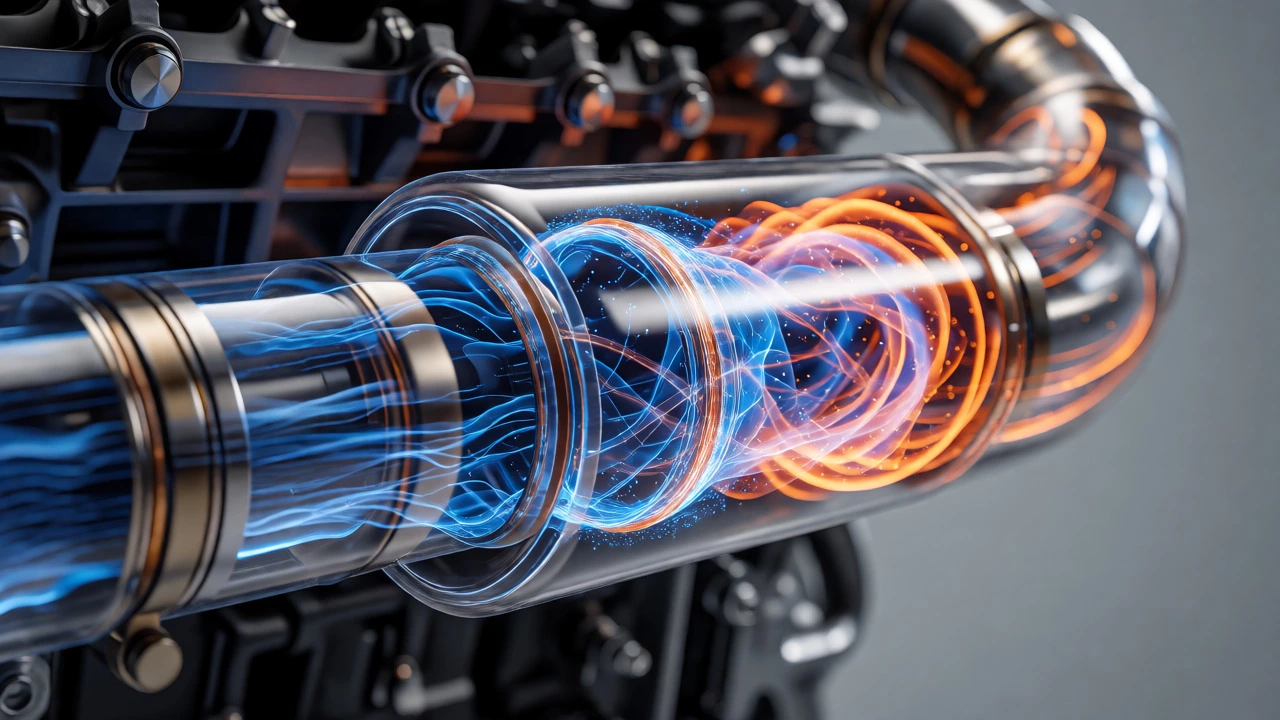
Think of your exhaust system like drinking through a straw. If the straw is too narrow, you can’t get enough liquid out fast enough, no matter how hard you suck. That’s restriction. But if the straw is a giant tube, you have to pull so hard to create suction that nothing comes up easily until you’ve built up massive pressure. That’s loss of velocity. Your exhaust gases need speed to help scavenge the next cylinder’s intake charge. This is called scavenging, and it relies on maintaining gas velocity.
For a 200 hp engine, you are dealing with a moderate volume of exhaust gases. The goal is to keep the gas velocity high enough to maintain torque across the rev range while allowing enough total volume to prevent backpressure from choking the top end. Backpressure is often misunderstood. Some backpressure is good-it helps maintain low-RPM torque by keeping exhaust gases moving slowly enough to allow complete combustion. Too much backpressure, however, acts like a brake on the engine, forcing pistons to work harder to push gases out.
Naturally Aspirated vs. Turbocharged Setups
This is where most people go wrong. They see a friend’s turbo car running 3-inch pipes and think they should do the same. Don’t. Turbocharged engines operate differently because the turbine extracts energy from the exhaust flow before it leaves the system. This means turbos are less sensitive to downstream pipe restrictions than naturally aspirated engines, but they still require proper sizing to spool efficiently.
| Engine Type | Primary Diameter | Secondary Diameter | Muffler Core | Notes |
|---|---|---|---|---|
| Naturally Aspirated Inline-4 | 2.25 - 2.5 inches | 2.5 inches | 1.75 - 2.0 inches | Best balance of torque and power. |
| Turbocharged Engine | 2.5 - 2.75 inches | 2.75 - 3.0 inches | 2.0 - 2.25 inches | Slightly larger allows faster spooling. |
| V6 / V8 (Low RPM Focus) | 2.5 inches | 2.5 - 3.0 inches | 2.0 inches | Larger displacement needs more volume. |
| Diesel (200 HP) | 2.5 - 3.0 inches | 3.0 inches | 2.25 inches | Diesels produce more exhaust mass. |
Notice the difference between the NA and Turbo rows. A turbocharged 200 hp engine can handle slightly larger piping without suffering the same low-end torque loss as a naturally aspirated one. This is because the turbocharger creates its own pressure differential, helping to pull exhaust gases through the system. If you put a 3-inch system on a naturally aspirated 2.0-liter engine making 200 hp, you will likely feel a distinct lag below 3,000 RPM. The exhaust gases won’t have enough force to maintain velocity in such a large pipe, leading to poor throttle response.
The Role of the Catalytic Converter and DPF
You cannot ignore the catalytic converter when sizing your exhaust. In the UK and most of Europe, removing cats is illegal for road use and causes MOT failures. The cat itself acts as a significant restriction. Most modern catalytic converters are designed to flow adequately for stock power levels. If you’ve upgraded to 200 hp, you might be pushing the limits of a stock cat.
If you are sticking with the factory cat, a 2.5-inch system is usually safe. Going larger than 2.75 inches immediately after the cat offers diminishing returns because the cat becomes the bottleneck. You’ll spend money on bigger pipes that don’t actually increase flow because the gases are already restricted upstream. Conversely, if you install a high-flow sports cat (like a 200-cell metallic core), you can benefit from the extra volume of a 2.5 to 2.75-inch system.
For diesel owners, the Diesel Particulate Filter (DPF) is even more restrictive. A 200 hp diesel typically produces more exhaust gas volume than a petrol equivalent due to lower combustion temperatures and higher air density. Here, a 3-inch system is often recommended to prevent excessive backpressure, which can cause the DPF to clog prematurely or trigger regeneration faults.
Header Design and Manifold Considerations
Pipe size doesn’t exist in a vacuum. It starts at the header or manifold. If you have a cast iron manifold, which is common on older or budget-friendly cars, the runners are often uneven lengths and rough inside. This creates turbulence. Trying to compensate for a bad manifold by oversizing the rest of the exhaust rarely works well.
Upgrading to tubular headers smooths out the flow and equalizes runner lengths. When paired with a properly sized mid-pipe, this synergy unlocks the true potential of your 200 hp build. For example, a 4-into-1 header design works best with a single collector merging into a 2.5-inch pipe. If you try to run two separate 2-inch pipes from a 4-into-1 header, you create conflicting pressure waves that can actually hurt performance. Stick to one unified path unless you have a very specific dual-exhaust tuning strategy.
Mufflers: Sound vs. Performance
A lot of enthusiasts skip mufflers entirely, thinking straight pipes mean maximum power. While true in theory, real-world driving suffers. Without a muffler, you get drone-a resonant hum that vibrates the entire cabin. Worse, some straight-pipe designs reflect sound waves back into the engine bay, potentially interfering with intake noise sensors or simply being unbearable.
For a 200 hp daily driver, a chambered or turbo-style muffler is ideal. These designs use baffles to cancel out specific frequencies without creating significant backpressure. Look for a muffler with a core size matching your pipe diameter. Putting a 2-inch core muffler on a 2.5-inch pipe creates a pinch point. Ensure the inlet and outlet diameters match your piping. Brands like Magnaflow and Walker offer universal fit options that are widely available in the UK.
Common Mistakes to Avoid
- Oversizing the tailpipes: Many people buy 3-inch tips for aesthetics. If your main system is 2.5 inches, tapering down to 2.5 inches at the tip is fine. Flaring directly from 2.5 to 3 inches without a transition cone can cause turbulence. Always use proper reducers or mandrel-bent transitions.
- Ignoring flex pipes: Your engine moves on mounts. A rigid stainless steel system without a flex section near the manifold will crack over time. Install a braided stainless flex pipe to absorb vibration.
- Cheap aluminized steel: In wet climates like Bristol, salt and moisture eat cheap steel. Invest in T304 stainless steel. It costs more upfront but lasts twice as long and maintains its internal smoothness, preventing rust buildup that restricts flow.
- Tuning neglect: Changing exhaust flow alters the air-fuel ratio slightly. After installing a new system, especially if you removed restrictions, get an ECU remap. A tune ensures you’re getting the full 200 hp safely.
How to Calculate Your Specific Needs
If you want to get technical, you can estimate the required flow area using the following rule of thumb: divide the horsepower by 100 to get the approximate cubic feet per minute (CFM) needed per inch of pipe diameter. For 200 hp, you need roughly 2 CFM per square inch of cross-sectional area. A 2.5-inch pipe has a cross-sectional area of about 4.9 square inches. 4.9 x 2 = 9.8 CFM capacity, which is more than enough headroom for 200 hp.
Why not go smaller? A 2-inch pipe has only 3.14 square inches of area. At 200 hp, you’d be pushing the limit of efficiency, risking heat soak and increased backpressure. Why not go bigger? A 3-inch pipe has 7.07 square inches. At 200 hp, the gas velocity drops significantly, hurting low-end response. The 2.5-inch middle ground preserves velocity while providing ample volume.
Installation Tips for DIYers
If you’re welding this yourself, mandrel bending is non-negotiable. Crush bends reduce the inner diameter by up to 20%, effectively shrinking your 2.5-inch pipe to a 2-inch restriction at every corner. Mandrel bends maintain the full diameter throughout the curve. Use hangers with rubber isolators rather than solid metal clamps to prevent stress cracks.
Check your clearance carefully. Larger pipes take up more room. Ensure the exhaust doesn’t touch the subframe, fuel lines, or brake lines. Heat wrapping the downpipe can help protect nearby components and keep exhaust gases hot, which improves flow efficiency since hotter gases expand and move faster.
Frequently Asked Questions
Will a bigger exhaust make my car louder?
Not necessarily. Loudness depends more on the muffler design and whether you have a catalytic converter than the pipe diameter. A 3-inch system with a quiet turbo-style muffler can be quieter than a 2-inch system with a glasspack. However, larger pipes do allow more sound frequencies to escape, which can change the tone from a rumble to a higher-pitched note.
Can I mix different pipe sizes?
Yes, but you must use gradual transitions. Stepping up from 2.25 inches to 2.5 inches and then to 2.75 inches is acceptable if done with proper cones. Abrupt changes create turbulence. Generally, keep the primary diameter consistent from the header to the muffler inlet for best results.
Does exhaust size affect fuel economy?
Marginally. A poorly sized exhaust that creates excessive backpressure forces the engine to work harder, burning more fuel. Correctly sizing the exhaust for 200 hp can improve efficiency by reducing pumping losses. However, the gains are small-perhaps 1-2 MPG-and shouldn't be the primary reason for upgrading.
Is 3 inches too big for 200 hp?
For a naturally aspirated engine, yes, it is likely too big and will hurt low-end torque. For a turbocharged engine or a diesel, 3 inches is acceptable and may even be beneficial for top-end power, provided the turbo or engine produces enough exhaust volume to maintain velocity.
Do I need a tune after changing exhaust size?
It is highly recommended. While a simple cat-back swap might not strictly require a tune, optimizing the air-fuel mixture and ignition timing to match the new flow characteristics will unlock additional power and ensure the engine runs smoothly across the rev range.