Suspension Health Checker
Check Your Suspension
Answer these questions to identify potential suspension issues. Based on the article, worn shocks and struts are the most common suspension problem.
DIY Bounce Test
Park on level ground and push down firmly on one corner of the car. Let go and observe how it bounces.
Suspension Health Score
What This Means:
Your suspension is healthy. Maintain with regular checks.
Consider inspection and possible replacement soon.
Immediate attention required for safety reasons.
Suspension Diagnosis
Your Suspension Status
Recommended Actions
- ✓ Schedule a professional inspection
- ✓ Consider replacement if score is 7+
- ✓ Check your tire alignment
If your car feels bouncy, shaky, or like it’s floating over bumps, you’re not imagining it. The most common problem in a suspension system is worn shocks and struts. It’s not flashy, it doesn’t make a loud noise, and it often sneaks up on drivers until one day, your car just doesn’t feel right anymore.
Why Worn Shocks and Struts Are the #1 Issue
Shocks and struts are the quiet heroes of your suspension. They don’t hold up the car-that’s what springs do. Instead, they control how the springs move. Think of them like the brakes for bouncing. Without them, your tires would hop over every bump, lose contact with the road, and make steering unpredictable.
Most manufacturers design shocks and struts to last between 50,000 and 100,000 miles. But in real life? If you drive on rough roads, carry heavy loads, or live somewhere with potholes and winter salt, they can wear out in half that time. A 2023 study by the National Highway Traffic Safety Administration found that 42% of vehicles over 8 years old had shocks or struts that failed basic bounce tests.
You won’t see cracks or rust on them most of the time. They don’t snap. They just slowly lose their ability to dampen movement. That’s why drivers often ignore them until they notice:
- Excessive bouncing after hitting a bump
- The car nose-diving when braking
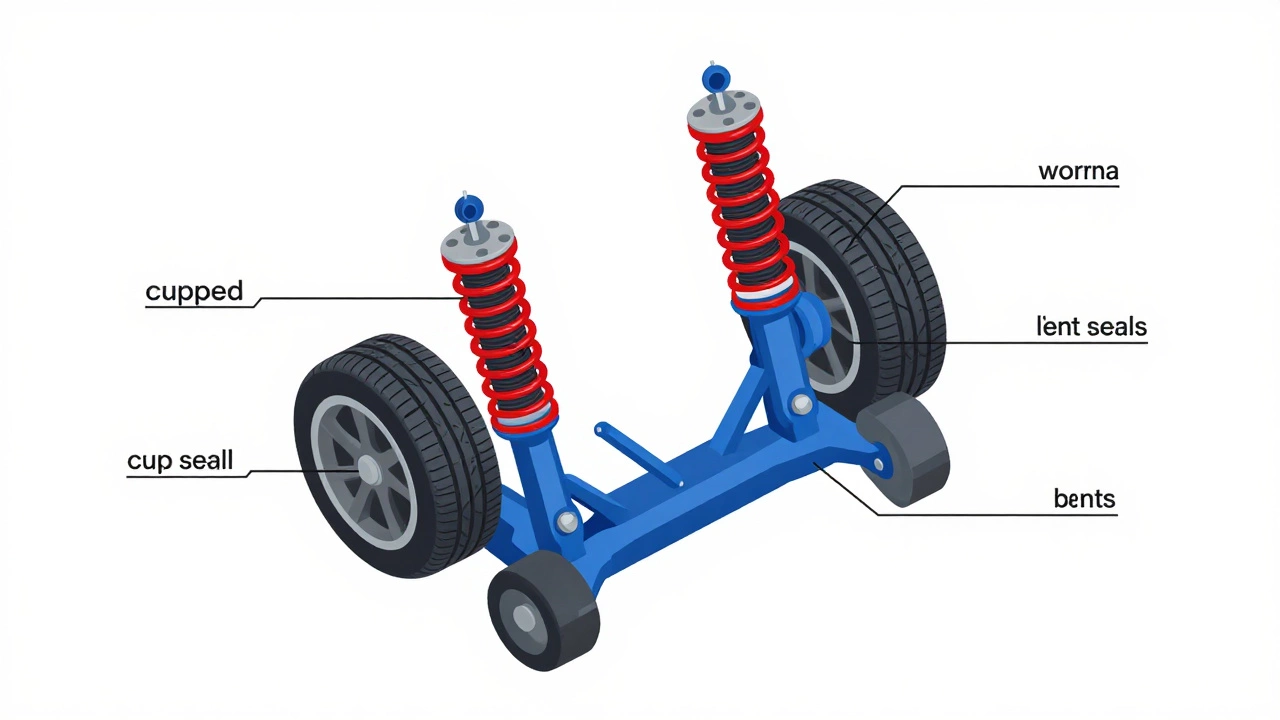
- Uneven tire wear (especially cupping-small dips along the tread)
- A feeling that the car is floating or swaying on highways
- More body roll when turning
What Happens When Shocks and Struts Go Bad
It’s not just about comfort. Worn suspension parts directly affect safety.
When shocks fail, your tires lose grip more easily. That means longer stopping distances. In wet conditions, you might hydroplane sooner. In emergency maneuvers, your car won’t respond as quickly. A test by the Center for Auto Safety showed that vehicles with worn struts took 12% longer to stop from 60 mph than those with new ones.
Also, your tires wear out faster. If you’re replacing tires every 25,000 miles instead of 50,000, worn shocks could be the hidden cause. You’re not just spending more on tires-you’re also risking blowouts from uneven wear patterns.
And then there’s the noise. A clunking or knocking sound when going over bumps? That’s often not the spring-it’s the strut mount or the shock’s top bearing wearing out. People mistake it for a bad ball joint or control arm, but more often than not, it’s the shock system itself.
How to Check Your Shocks and Struts Yourself
You don’t need a lift or special tools. Here’s a simple test you can do at home:
- Park on level ground and push down firmly on one corner of the car-front or back.
- Let go and watch how it bounces.
- If it bounces more than once or twice, the shock or strut is likely worn.
That’s the bounce test. It’s not perfect, but it catches 80% of failing units.
Look under the car too. Check for oil leaks around the shock body. A little dampness is normal. A wet, oily shock? That’s a sign the internal seal has failed. Also, check for bent or damaged mounting brackets. Rust on the strut tower? That’s a red flag, especially if you live near the coast or in snowy areas.

What Else Can Go Wrong in a Suspension System
Worn shocks and struts are the main problem-but they’re not the only ones. Here’s what else commonly fails:
- Control arms: The bushings wear out, causing clunks and misalignment. Often confused with bad shocks.
- Ball joints: If your steering feels loose or your tires wear on the inside or outside edge, this could be the culprit.
- Sway bar links: These connect the sway bar to the control arms. When they go, you’ll hear rattling over bumps and feel more body roll.
- Spring sag: Springs don’t usually break-they just get weak. If your car sits lower than it used to, especially in the back, the springs are tired.
- Mounting hardware: Strut mounts, bearings, and bolts corrode. They’re cheap to replace but often overlooked.
Here’s the thing: these parts don’t fail in isolation. If your shocks are worn, your control arms are taking extra stress. If your ball joints are loose, your shocks are working harder. That’s why it’s smart to inspect the whole system when you replace one part.
When to Replace Them
Don’t wait for a complete failure. Here’s when to act:
- At 50,000-70,000 miles if you drive mostly on rough roads
- At 80,000-100,000 miles for highway-driven cars
- Immediately if you notice fluid leaks, excessive bouncing, or uneven tire wear
- Before a long road trip if your car is over 8 years old
Some mechanics recommend replacing shocks and struts in pairs-front or rear together. That’s because mismatched parts create uneven handling. If you replace just one front strut, your car will pull slightly to one side when braking. It’s not dangerous, but it’s annoying and can wear out other parts faster.
What to Expect When Replacing Them
Replacing shocks and struts isn’t a weekend job for beginners. It requires spring compressors, torque wrenches, and knowledge of suspension geometry. Most people take it to a shop.
Costs vary. Front struts for a Honda Civic might run £180-£250 for parts and labor. For a larger SUV like a Ford Explorer, it could be £400-£600. Premium brands like Bilstein or Koni cost more but last longer and handle better.
Don’t just go for the cheapest option. Cheap shocks might save you £50 now but wear out in 20,000 miles. You’ll pay twice in the long run.
How to Make Them Last Longer
There’s no magic trick, but you can stretch their life:
- Avoid potholes and curbs. They’re the #1 killer of suspension parts.
- Don’t overload your car. Excess weight stresses shocks and springs.
- Get a wheel alignment every 10,000 miles or after hitting a major bump.
- Wash undercarriage in winter to reduce rust on mounts and links.
- Check your suspension during oil changes-just glance under the car.
Most people forget their suspension until something breaks. But a healthy suspension is the difference between a car that feels solid and one that feels like it’s falling apart.
How do I know if my shocks are worn out?
Look for signs like excessive bouncing after hitting a bump, the car dipping forward when braking, uneven tire wear (especially cupping), or a floating feeling on highways. You can also do the bounce test: push down on a corner of the car and let go. If it bounces more than twice, the shocks are likely worn.
Can worn shocks affect my tires?
Yes. Worn shocks cause tires to bounce and lose contact with the road, leading to uneven wear patterns called cupping-small dips along the tread. This reduces tire life by up to 30% and can create dangerous vibrations at high speeds.
Is it safe to drive with bad shocks?
It’s risky. Worn shocks increase stopping distances, reduce control in wet or icy conditions, and make emergency maneuvers less effective. In a 2023 NHTSA study, vehicles with failed shocks were 15% more likely to be involved in accidents due to loss of control.
Should I replace shocks and struts in pairs?
Always. Replacing only one side creates uneven damping, which can cause pulling during braking, uneven tire wear, and unstable handling. Replace both front or both rear units together-even if only one looks bad.
How much does it cost to replace shocks and struts?
For a compact car, expect £180-£250 per axle. For larger vehicles like SUVs or trucks, it’s £400-£600 per axle. Labor makes up most of the cost. Premium brands like Bilstein or Koni cost more but offer better ride quality and longer life.