If your car sputters, stalls, or refuses to start - especially after warming up - and you’ve checked the battery and spark plugs, the culprit might be your fuel pump. But how do you know for sure? Modern cars don’t just warn you with a light. They throw specific diagnostic trouble codes (DTCs) that tell mechanics exactly where the problem lies. Knowing which codes point to a failing fuel pump saves time, money, and guesswork.
Common Fuel Pump Trouble Codes
When a fuel pump starts to fail, it doesn’t always die all at once. It often weakens gradually, causing inconsistent fuel pressure. The engine control module (ECM) notices this and logs a code. Here are the most common ones you’ll see:
- P0190 - Fuel Rail Pressure Sensor Circuit Malfunction
- P0230 - Fuel Pump Primary Circuit Malfunction
- P0231 - Fuel Pump Low Output
- P0232 - Fuel Pump High Output
- P0087 - Fuel System Pressure Too Low
- P0088 - Fuel System Pressure Too High
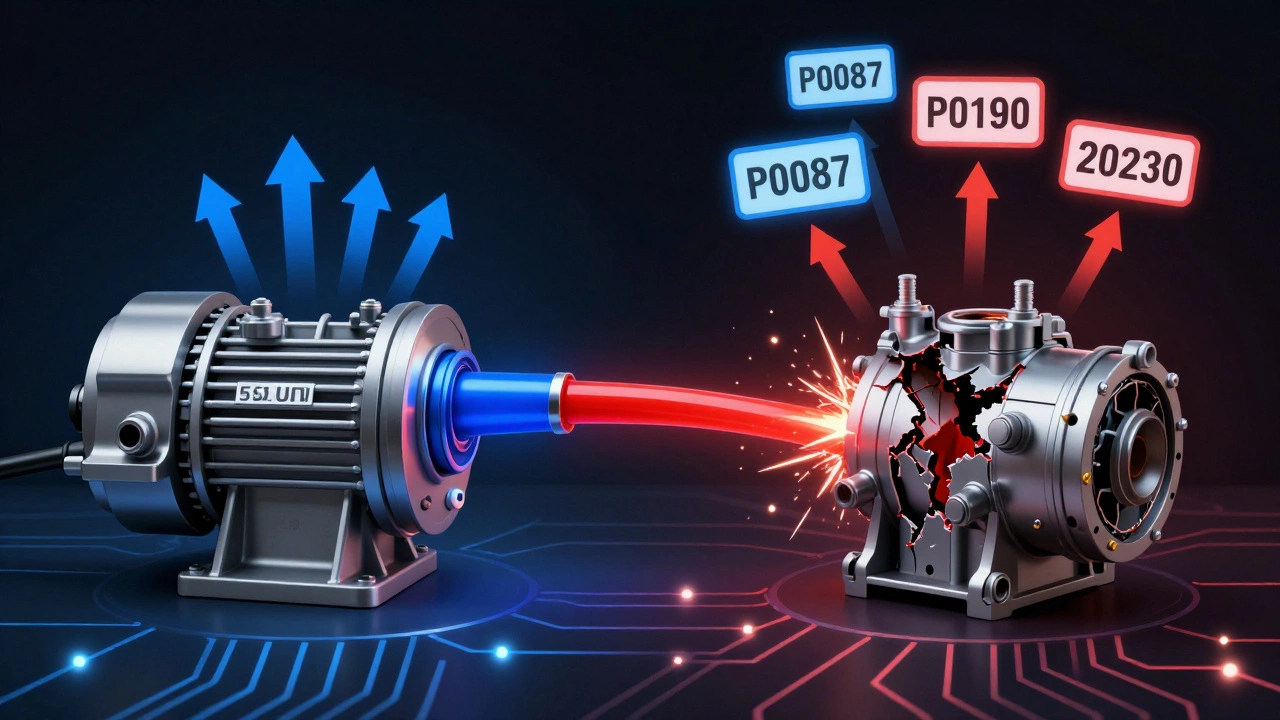
These codes don’t always mean the fuel pump itself is dead. But if you’re seeing one or more of these - especially P0230 or P0190 - and the pump is original or over 100,000 miles old, it’s a strong indicator.
What P0230 Really Means
P0230 is the most direct fuel pump code. It means the ECM detected a problem in the primary circuit powering the fuel pump. This could be a blown fuse, a bad relay, corroded wiring, or a failing pump drawing too much or too little current. Most people assume the pump is dead when they see this code. But before replacing it, check the fuse and relay first. A $5 relay or a corroded connector can mimic a bad pump.
Here’s how to test it: Turn the key to “ON” (don’t start the engine). Listen near the fuel tank. You should hear a brief 2-3 second hum - that’s the pump priming. If you hear nothing, the circuit is interrupted. If you hear a weak whine or clicking, the pump is struggling. No hum? Start with the fuse box. Most cars have a dedicated fuel pump fuse labeled “F/P” or “Fuel.”
P0190 and Fuel Pressure Sensor Issues
P0190 is trickier. It points to the fuel pressure sensor, not the pump. But here’s the catch: if the sensor is working fine and the pressure is low, the pump is the likely cause. The sensor just reports what it sees. If it’s reading 20 psi when it should be 45 psi, the pump isn’t delivering enough fuel - even if the sensor is perfect.
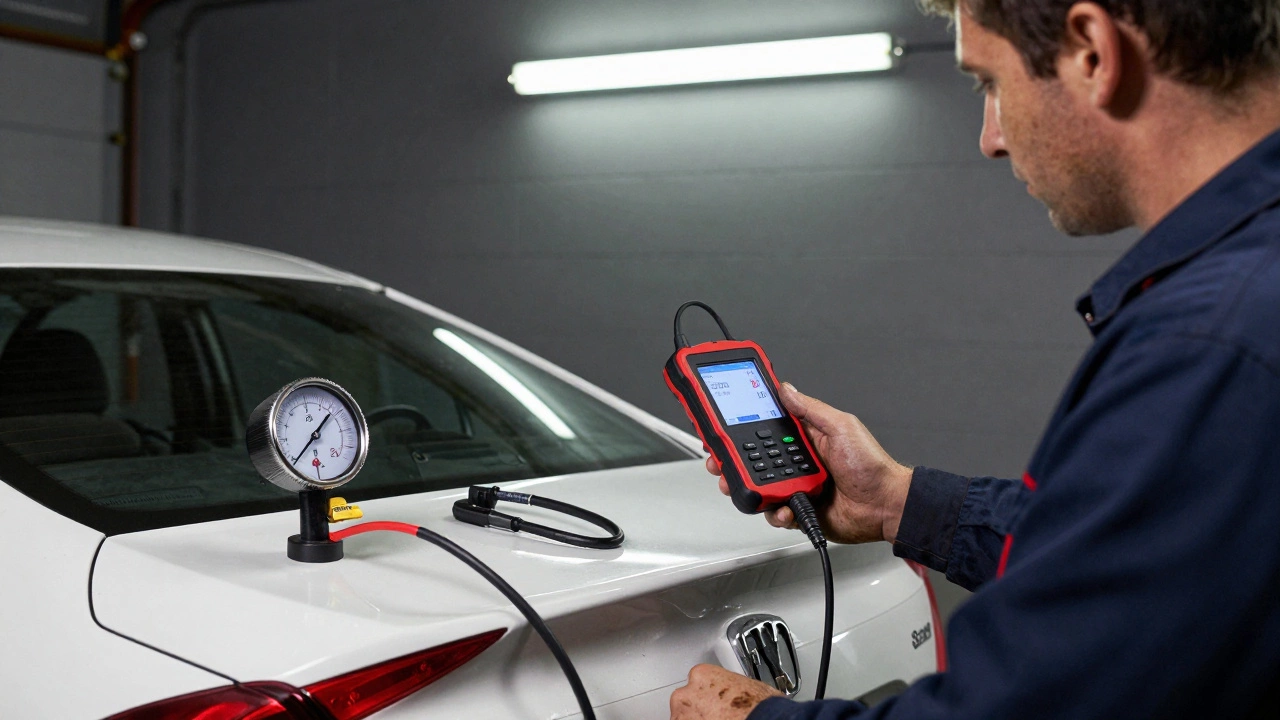
Many mechanics skip testing fuel pressure and just replace the sensor. That’s a mistake. A $200 sensor replacement won’t fix a $150 fuel pump problem. Always verify pressure with a gauge. You can rent a fuel pressure tester from most auto parts stores. Hook it up to the fuel rail test port (usually under the hood near the injectors). Compare the reading to your vehicle’s specs - found in the repair manual or online databases like ALLDATA or Mitchell1.
Why P0087 Shows Up More Than You Think
P0087 - Fuel System Pressure Too Low - is one of the most common codes you’ll see on modern direct-injection engines. These engines need much higher fuel pressure than older port-injected ones. A weak pump that worked fine on a 2005 Camry might not cut it on a 2020 Ford Focus.
But P0087 can also come from clogged fuel filters, leaking injectors, or even a faulty pressure regulator. That’s why it’s not a standalone fuel pump code. Still, if you’ve ruled out the filter (replace it every 40,000 miles anyway) and the injectors are clean, the pump is the next logical suspect. On many late-model cars, the fuel filter is built into the pump assembly. So if it’s clogged, you’re replacing the whole unit.
Real-World Example: A 2018 Honda Civic That Wouldn’t Start
A customer brought in a 2018 Civic with a P0230 and P0087. The battery was fine. Spark was good. No codes for injectors or sensors. We checked the fuel pump relay - it clicked fine. We swapped it with the horn relay just to be sure. Still no start. We hooked up a pressure gauge. Readings hovered at 22 psi. Normal for this car? 55 psi. We pulled the fuel pump. The impeller blades were worn down, and the motor was sluggish. The pump was 98,000 miles old. Replaced it. Car started on the first try. No more codes.
This isn’t rare. Fuel pumps don’t usually fail without warning. They fade. You might notice the car hesitates on highway merges. Or it takes longer to start after sitting overnight. Those are the early signs. Waiting until the car won’t start at all means you’re stranded.
What Codes Won’t Tell You
Not every fuel pump problem throws a code. Older cars (pre-2000) don’t have the sensors to detect low pressure. Even some newer ones won’t log a code until the pressure drops below a critical threshold. That’s why listening for the pump hum and checking pressure manually is still essential.
Also, a fuel pump can fail intermittently. It works fine when cold, but heats up after 20 minutes of driving and cuts out. The ECM might not catch it in time to set a code. That’s when you need to test under load. Drive the car until it starts acting up, then immediately check pressure with the gauge.
How to Confirm It’s the Pump - Not Something Else
Before you spend $400 on a new pump, rule out these common mimics:
- Bad fuel filter: Clogged filters starve the pump. Replace it if it’s never been changed.
- Faulty fuel pressure regulator: Common on older GM and Ford vehicles. Leaking fuel back into the return line lowers pressure.
- Electrical issues: Corroded connectors at the pump, damaged wiring harnesses, or a weak ground can all cause low power to the pump.
- Low fuel level: Running the tank below 1/4 full regularly causes the pump to overheat. The fuel cools the pump. No fuel? No cooling.
Here’s a quick checklist:
- Check the fuse and relay.
- Listen for the pump hum when turning the key to ON.
- Test fuel pressure with a gauge.
- Inspect the fuel filter - is it dirty or overdue?
- Check for voltage at the pump connector with a multimeter (should be 12-13V when cranking).
If all those check out and pressure is still low - it’s the pump.
What Happens If You Ignore It?
Driving with a weak fuel pump doesn’t just cause inconvenience. It can damage other parts. When the pump struggles, it runs hotter. That heat can crack the fuel tank lining or melt plastic components inside the fuel module. In direct-injection engines, low fuel pressure can cause carbon buildup on intake valves because the fuel isn’t washing them clean. That leads to rough idling, poor fuel economy, and eventually expensive intake cleaning.
And if the pump dies completely? You’re not just stranded. You’re risking engine damage. Modern engines rely on precise fuel delivery. Too little fuel = lean condition = overheating, detonation, and possible piston or valve damage.
How Long Do Fuel Pumps Last?
Most fuel pumps are designed to last 100,000 to 150,000 miles. But that’s under ideal conditions. If you frequently run on empty, use cheap fuel, or drive in dusty areas, they can fail as early as 60,000 miles. In cities with bad fuel quality - like some areas in the UK - pumps wear faster. I’ve seen pumps fail at 50,000 miles in Bristol due to ethanol-blended fuel and poor station maintenance.
There’s no scheduled replacement for fuel pumps. But if your car is over 10 years old or has over 80,000 miles, and you’re seeing any of the symptoms - hesitation, hard starts, stalling - don’t wait for the code to come. Get it checked.
What to Look for When Replacing It
Not all fuel pumps are created equal. Aftermarket brands like Bosch, Denso, and Delphi are reliable. Avoid no-name brands sold on Amazon or eBay. They often have weaker motors, poor seals, or incompatible flow rates.
Also, make sure you’re buying the right part for your exact model. A pump for a 2017 Toyota Corolla won’t fit a 2017 Corolla Hybrid - even if they look similar. The flow rate, voltage, and connector shape can vary. Always match the OEM part number.
And if you’re replacing the pump, replace the fuel filter too - even if it’s not scheduled yet. Most modern pumps have the filter built in. You’re already pulling the tank. Do it right.
Can a bad fuel pump cause the check engine light to come on?
Yes. A failing fuel pump often triggers codes like P0230, P0190, or P0087, which will turn on the check engine light. But not always - especially if the failure is intermittent or the car is older than 2000.
Will a bad fuel pump throw a code even if the car still runs?
Yes. Fuel pumps often fail gradually. The engine might run, but poorly - with hesitation, misfires, or stalling under load. The ECM detects low pressure or circuit issues and logs a code long before the car completely dies.
Can I drive with a bad fuel pump?
You can, but you shouldn’t. Driving with a weak pump strains the engine, risks overheating, and can damage fuel injectors or cause internal engine damage from lean conditions. It’s also unsafe - the car could stall on the highway.
How much does it cost to replace a fuel pump?
Parts range from $150 to $400 depending on the car. Labor is $200 to $500 because the tank often needs to be dropped. Total: $350 to $900. Buying OEM or reputable aftermarket parts saves money long-term by avoiding repeat failures.
Do I need to drain the fuel tank to replace the pump?
It’s not always required, but it’s highly recommended. Most mechanics drain the tank to below 1/4 full to reduce weight and risk of spillage. Some cars have a fuel pump access panel under the rear seat - no tank removal needed. Check your repair manual.
Can a clogged fuel filter cause the same codes as a bad fuel pump?
Yes. A clogged filter restricts fuel flow, causing low pressure that triggers P0087 or P0190. That’s why replacing the filter is always step one - it’s cheaper and easier than replacing the pump.