Clutch Replacement Labor Calculator
How Long Will Your Clutch Replacement Take?
Enter your vehicle details to get an estimate of labor hours required.
Enter your vehicle details to see an estimate.
Replacing a clutch isn’t like changing your oil. It’s one of the most time-consuming jobs you can do on a car, and if you’ve never done it before, you might be surprised by how long it takes. Most mechanics will tell you it’s a full-day job - sometimes even longer. But how many labor hours does it really take? The answer depends on your car, your skill level, and whether you’re doing it right the first time.
Typical Labor Hours for Clutch Replacement
On average, replacing a clutch takes between 4 and 8 hours of labor. That’s not just a quick afternoon project - it’s a full workday for most garages. For simpler cars like a Honda Civic or a Toyota Corolla, you might get away with 4 to 5 hours if everything goes smoothly. But for more complex setups - like rear-wheel-drive cars, SUVs, or vehicles with tight engine bays - you’re looking at 6 to 8 hours, sometimes even 10.
Why so long? Because the clutch isn’t a single part you swap out. You have to remove the transmission, separate it from the engine, pull off the old clutch assembly, inspect the flywheel, install the new clutch kit, reassemble everything, bleed the hydraulic system, and then test it. Each step requires precision. One wrong torque setting or misaligned component, and you’re risking damage or premature failure.
What Affects Clutch Replacement Time?
Not all cars are created equal when it comes to clutch access. Here’s what changes the clock:
- Drive configuration: Front-wheel-drive cars usually take less time because the transmission is easier to remove. Rear-wheel-drive and all-wheel-drive vehicles often require lifting the engine or removing subframes, adding 1-3 hours.
- Engine size and layout: Inline-four engines are straightforward. V6 or V8 engines, especially in tight compartments like older BMWs or Ford Mustangs, slow things down.
- Transmission type: Manual transmissions are standard for clutch jobs, but dual-clutch or automated manuals (like those in some VWs or Porsches) can double the time due to extra electronics and calibration needs.
- Accessories and components: If the starter, exhaust manifold, or coolant lines are in the way, you’ll need to disconnect them. Some cars have the clutch slave cylinder mounted inside the bellhousing - that’s a 30-minute detour right there.
- Flywheel condition: If the flywheel is worn or cracked, you’ll need to replace or resurface it. That adds another hour or two, and you’ll need to buy a new one or pay for machining.
For example, replacing a clutch in a 2018 Volkswagen Golf GTI takes about 6.5 hours. A 2005 Ford F-150 with a 5.4L V8? That’s closer to 8.5 hours. And a 2012 Subaru WRX? With its boxer engine and tight packaging, it’s often 9 hours or more - especially if the clutch hydraulic line is rusted shut.
What’s Included in a Clutch Kit?
A clutch kit isn’t just the disc. A complete kit usually includes:
- Clutch disc (friction material)
- Pressure plate
- Release bearing (also called throw-out bearing)
- Alignment tool (sometimes included)
- Slave cylinder (in some kits)
- Input shaft seal
Some mechanics recommend replacing the pilot bearing or bushing too - it’s cheap and easy to do while the transmission is out. If you skip it and it fails later, you’re back in the same spot. Same goes for the hydraulic line or master cylinder if they’re old or leaking. You don’t want to replace the clutch, drive 500 miles, and then have to do it again because a seal blew.
Why You Shouldn’t Rush the Job
There’s a reason reputable shops don’t promise a clutch replacement in 2 hours. If you’ve ever seen a DIYer try to force a transmission back into place without the alignment tool, you know what happens. The input shaft doesn’t line up, the clutch disc gets cocked, and you grind the splines. That’s a $2,000 mistake.
Proper torque matters too. Pressure plates need to be tightened in a star pattern, in stages, to exact specs. Over-tighten, and you warp the plate. Under-tighten, and it slips. Both ruin the clutch fast.
And don’t forget the bleed. Hydraulic clutches need to be bled perfectly. Air in the line means a spongy pedal, incomplete disengagement, and gear grinding. It’s not just a quick pump - you need to follow the manufacturer’s bleeding procedure, often with a helper or a vacuum tool.
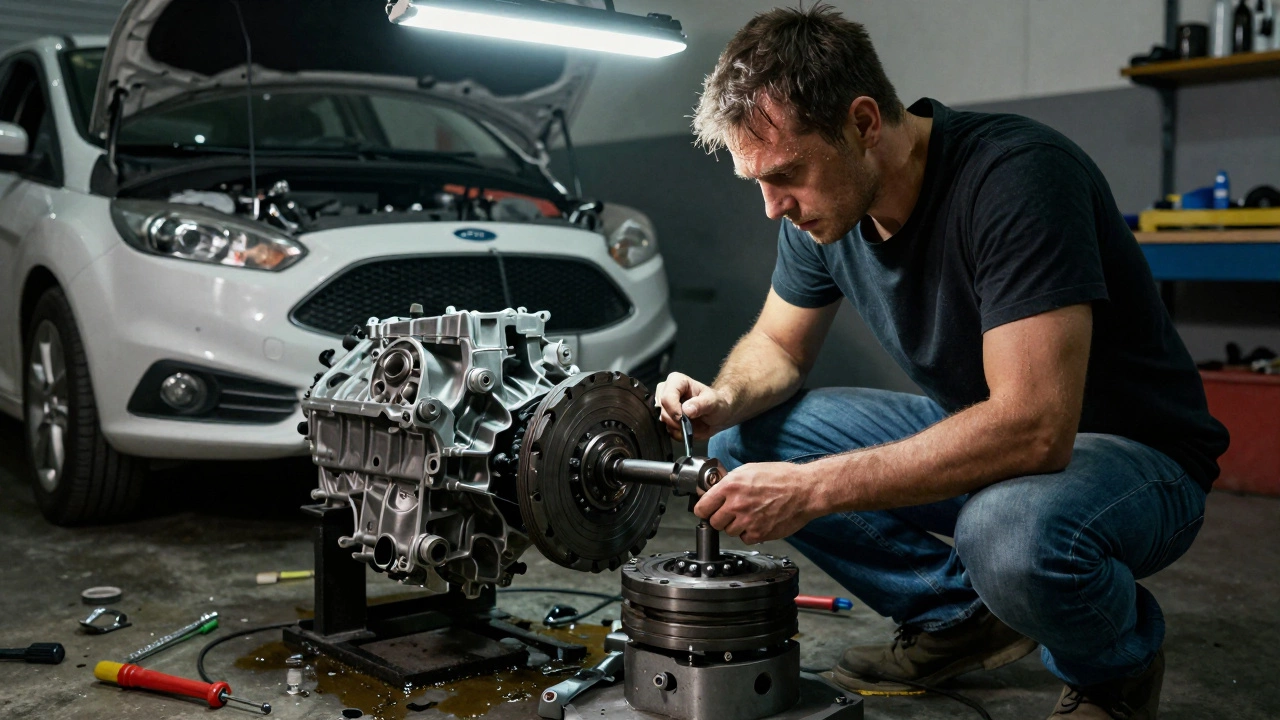
Can You Do It Yourself?
Yes - if you’re patient, have the right tools, and know how to use them. Many people replace their own clutches to save money. But here’s the catch: the labor cost is usually the biggest part of the bill. A shop might charge $1,200 for the job, but $900 of that is labor. The clutch kit itself? $300-$600.
If you’re comfortable with basic tools, a jack, jack stands, and torque wrenches, you can save a lot. But you’ll need:
- Transmission jack (or a sturdy helper)
- Clutch alignment tool
- Socket set with torque wrench
- Hydraulic clutch bleeder kit
- Shop manual or digital repair guide for your exact model
And you’ll need time. Even experienced DIYers take 6-10 hours on their first clutch job. Don’t plan to do it in one evening. Spread it over a weekend. You’ll make fewer mistakes.
Signs You Need a New Clutch
You don’t need to wait until the clutch dies completely. Here’s what to watch for:
- Slipping: Engine revs up, but the car doesn’t accelerate - especially under load or uphill.
- Hard pedal: You have to press the pedal all the way to the floor to shift.
- Grinding noises: When shifting, especially into first or reverse.
- Clutch pedal feels spongy: Air in the hydraulic system or a worn master/slave cylinder.
- Clutch smells like burning: That’s friction material overheating from slipping.
These aren’t always sudden failures. Most clutches last 60,000 to 100,000 miles, but aggressive driving, stop-and-go traffic, or towing can cut that in half.
What Happens If You Delay Replacement?
Driving with a worn clutch doesn’t just make shifting harder - it can wreck other parts. If the clutch disc is glazed or cracked, it can damage the flywheel. If the pressure plate springs break, they can puncture the transmission housing. A slipping clutch puts extra stress on the transmission gears, leading to premature wear.
And if it fails completely while you’re driving? You might be stranded. No clutch means no power transfer. You can’t change gears. You can’t pull away from a stop. It’s not just inconvenient - it’s unsafe.

Real-World Example: A Bristol-Based Case
A customer in Bristol brought in a 2014 Ford Focus ST with 92,000 miles. The clutch slipped badly on hills. The car was used for weekend track days, so wear was expected. The job took 7.5 hours: 1 hour to drain fluid, 2 hours to remove the transmission, 1.5 hours to replace the clutch kit and flywheel, 1 hour to reinstall, and 2 hours to bleed the system and test.
They replaced the clutch kit, flywheel, and slave cylinder. Total labor: 7.5 hours. Parts cost: £480. Total bill: £820. If they’d waited until the clutch failed on the motorway, they’d have needed a tow, a rental car, and possibly transmission damage - costing over £2,000.
How to Save on Labor Costs
Here’s how to cut the labor bill without cutting corners:
- Buy your own clutch kit: Many shops charge a markup on parts. Buy a reputable brand (like Sachs, LUK, or Valeo) and bring it in. You’ll save 15-25%.
- Replace the flywheel at the same time: Even if it looks okay, it’s cheaper to do it now than to pay for labor again in 20,000 miles.
- Choose a local independent mechanic: Dealerships charge more. Independent shops with clutch specialists often have better rates and faster turnaround.
- Ask for a flat-rate estimate: Some shops charge by the hour. Others use flat-rate guides (like Mitchell or Alldata). Flat-rate gives you a fixed price.
Don’t go for the cheapest quote. Look for someone who’s done this job 50+ times. Clutch replacement is one of those jobs where experience matters more than price.
Final Thoughts
Replacing a clutch isn’t a weekend hobby unless you’re prepared. It’s a serious job that takes real time, real tools, and real care. Whether you’re doing it yourself or paying a mechanic, expect 4 to 8 hours of labor. Budget extra time for surprises - rusted bolts, broken bolts, or a seized slave cylinder.
And remember: a good clutch job lasts. A rushed one won’t. Take your time. Get it right. Your transmission will thank you.
How long does it take to replace a clutch in a typical family car?
For most front-wheel-drive family cars like a Honda Civic or Toyota Corolla, a professional mechanic will take about 4 to 5 hours. If the car is older or has rusted components, it could stretch to 6 hours. DIYers should plan for 6 to 8 hours, especially on their first attempt.
Can I replace a clutch without removing the transmission?
No. The clutch is sandwiched between the engine and the transmission. To access it, you must separate the transmission from the engine. There are no shortcuts. Some people try to avoid removing the transmission by cutting the bellhousing - that’s dangerous and not recommended.
Should I replace the flywheel when replacing the clutch?
Yes, if the flywheel shows signs of wear, cracking, or heat damage. Even if it looks okay, it’s often worth replacing it - especially if your car has a dual-mass flywheel. Replacing it now saves you from paying labor twice. A new flywheel costs $150-$400, but labor to remove the transmission again could be $600 or more.
What’s the average cost of a clutch replacement including labor?
Total cost ranges from $1,000 to $2,500, depending on the car. Labor makes up most of it - $600 to $1,200. Parts (clutch kit, flywheel, slave cylinder) usually cost $300 to $800. Luxury or performance cars can cost more due to specialized parts and longer labor times.
How do I know if my clutch is failing?
Signs include slipping (engine revs but car doesn’t accelerate), a spongy or hard clutch pedal, grinding noises when shifting, or a burning smell. If you notice any of these, don’t wait. Driving with a bad clutch can damage the transmission.