Exhaust Upgrade Decision Tool
Your Requirements
Slip-On
- Cost: Low
- DIY Friendly
- Minimal Power Gain
Full System
- Cost: High
- Pro Install Rec.
- Max Power Gain
Why this choice?
Enter your requirements to see which exhaust system fits your needs.
You’ve been dreaming about that deeper growl from your engine. You want the sound of a properly tuned machine, maybe a bit more power under the hood, and definitely something that looks sharper than the factory setup. But when you walk into an auto shop or browse online, two main options keep popping up: the slip-on exhaust and the full exhaust system. They both promise better sound and performance, but they come with wildly different price tags, installation requirements, and legal implications.
Choosing between them isn’t just about which one sounds cooler. It’s about balancing your budget, your mechanical skills, and how much attention you want to draw on the road. Get it wrong, and you might end up with a drone that gives you headaches, a fine for being too loud, or a check-engine light because you messed with emissions controls. Let’s break down exactly what each system does, who it’s for, and how to pick the right one without wasting money.
What Is a Slip-On Exhaust?
A slip-on exhaust is a direct-fit replacement for the muffler and tailpipe section of your stock exhaust system. Think of it as swapping out the speaker in your stereo while keeping the same amplifier and wiring. The front part of your original exhaust-the catalytic converter and the pipes leading up to the rear axle-stays exactly where it was. You simply cut off the old muffler and slide the new unit over the existing pipe.
This design makes slip-ons incredibly popular among first-time modifiers. Brands like Borla, Flowmaster, and MagnaFlow have spent decades perfecting these units. They are engineered to bolt on or clamp onto almost any major vehicle platform. If you drive a Ford F-150, a Chevrolet Silverado, or even a Honda Civic, there is likely a slip-on made specifically for your VIN number.
The primary benefit here is simplicity. Most slip-ons weigh significantly less than the heavy, rusted-out factory mufflers they replace. This slight weight reduction helps, but the real draw is the sound change. You get a richer tone, often described as a "muscle car" rumble or a sporty burble, depending on the brand. However, because the restrictive catalytic converter remains in place, you won’t see massive horsepower gains. We’re talking about negligible improvements, perhaps 1 to 3 horsepower at best, mostly due to reduced backpressure in the final stage.
What Is a Full Exhaust System?
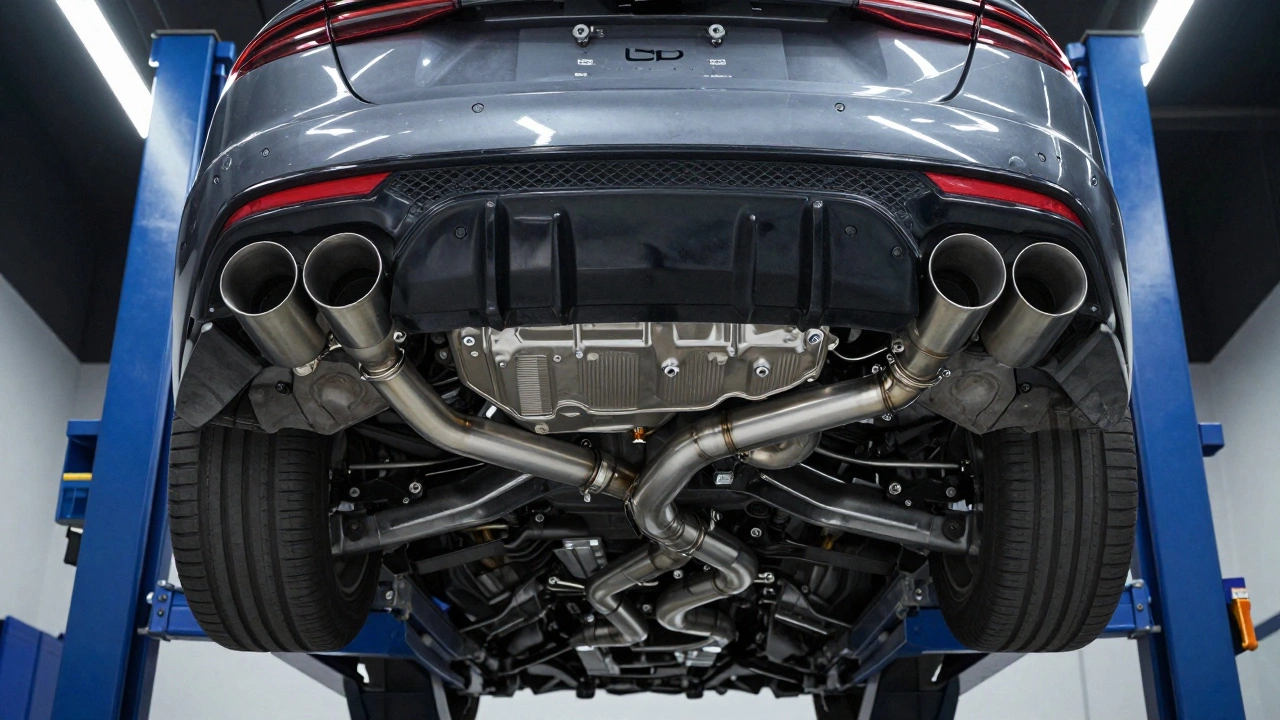
A full exhaust system, often referred to as a cat-back exhaust or header-back exhaust, replaces the entire exhaust path from the engine manifold or catalytic converter all the way to the tailpipe. This includes the downpipes, mid-pipes, mufflers, resonators, and tips. It is a complete overhaul of how gases exit your engine.
When people talk about a "full system," they usually mean one of two things. A cat-back system starts after the catalytic converter. A header-back system replaces the exhaust manifolds (headers) at the engine block itself. Both types remove the restrictive bends and narrow pipes found in factory designs. Factory exhausts are designed for cost-efficiency and meeting strict emissions standards, not for maximum airflow. By replacing them with larger diameter pipes (often 2.5 inches or 3 inches instead of the stock 2 inches) and smoother mandrel-bent sections, you allow the engine to breathe much more freely.
The result? Significant performance gains. On naturally aspirated engines, a full system can yield 5 to 10 horsepower. On turbocharged vehicles, removing the restriction in the downpipe alone can unlock substantial torque and boost response. The sound is also dramatically different. Without the factory resonators and heavy muffling, a full system produces a louder, more aggressive note. It’s not just a volume increase; the character of the sound changes entirely, often revealing the engine's natural frequency.
Key Differences: Cost, Installation, and Sound
| Feature | Slip-On Exhaust | Full Exhaust System |
|---|---|---|
| Price Range | $200 - $600 | $800 - $2,500+ |
| Installation Difficulty | Easy (DIY friendly) | Moderate to Hard (Pro recommended) |
| Horsepower Gain | Minimal (1-3 HP) | Noticeable (5-15+ HP) |
| Noise Level | Mild to Moderate | Loud to Very Loud |
| Emissions Impact | None (Stock CAT retained) | Potential issues if CAT removed |
| Warranty Risk | Low | High (May void powertrain warranty) |
Cost is the biggest divider. A quality slip-on is an affordable weekend project. You can buy the parts, rent a jack, and install it yourself in an afternoon. A full system is an investment. High-end stainless steel systems from brands like Borla ATAK, Corsa, or HJS run expensive. Plus, professional installation adds another $300 to $600 to the bill because welding or complex clamping is often required.
Sound is subjective, but data helps. Slip-ons typically add 3 to 6 decibels (dB) over stock. It’s noticeable to you, but neighbors probably won’t complain. Full systems can add 10 to 15 dB. That’s a significant jump. In many UK localities, including Bristol, exceeding 90 dB at idle or having excessive noise while driving can lead to fines under the Noise Act 1996. Always check local regulations before going full throttle.
Performance Gains: Real or Marketing Hype?
Let’s be honest: most drivers care more about sound than actual horsepower. But if performance is your goal, you need to understand airflow dynamics. An engine works by sucking air in, burning fuel, and pushing exhaust out. If the exhaust can’t escape quickly enough, it creates backpressure, choking the engine.
Factory exhausts use small-diameter pipes and tight bends to save space and reduce manufacturing costs. They also include a catalytic converter, which is essentially a honeycomb structure designed to trap pollutants. While essential for legality, it restricts flow. A slip-on leaves this bottleneck intact. You’re clearing the drain at the very end of the sink, but the pipe leading to it is still clogged.
A full system clears the whole line. By using larger diameter pipes and smoother bends, exhaust gases exit faster. This reduces pumping losses, allowing the pistons to push against less resistance. For turbocharged cars, this is critical. Turbos spin using exhaust gas energy. A restricted exhaust chokes the turbo, causing lag. A free-flowing full system allows the turbo to spool faster, improving throttle response. For naturally aspirated V8s, the gain is smaller but still measurable in the upper RPM range.
Legal and Warranty Considerations
In the UK, modifying your exhaust has legal boundaries. The Road Vehicles (Construction and Use) Regulations state that exhaust systems must not emit excessive noise. While there is no specific decibel limit written in stone for everyday driving, police officers can issue a fixed penalty notice if they deem the noise unreasonable. Slip-ons are generally safe here. Full systems, especially those with deleted resonators, risk crossing that line.
Then there’s the MOT test. Your vehicle must pass an inspection for leaks and excessive noise. A poorly installed full exhaust might leak at the joints, failing the MOT immediately. Even if it doesn’t leak, if the examiner thinks it’s too loud, you fail. Keep the paperwork from your installer proving the system meets emissions standards, though this rarely stops a subjective noise judgment.
If your car is under manufacturer warranty, be cautious. The Magnuson-Moss Warranty Act in the US protects consumers, but UK law is stricter regarding modifications that affect emissions or safety. Installing a full system that removes or modifies the catalytic converter will almost certainly void your emissions-related warranty coverage. Dealerships can argue that increased exhaust temperatures or altered airflow damaged other components. Stick to slip-ons if you want to keep your warranty intact.

Which One Should You Choose?
Your decision depends on three factors: budget, goals, and tolerance for attention.
- Choose a Slip-On if: You want a subtle sound upgrade, you’re on a tight budget, you plan to do the installation yourself, or you want to keep your car street-legal and warranty-safe. It’s the perfect entry point for anyone curious about exhaust mods.
- Choose a Full System if: You track your car, you want maximum horsepower, you don’t mind spending $1,500+, and you’re okay with a louder, more aggressive presence. This is for enthusiasts who view their car as a performance machine, not just transportation.
If you’re unsure, start with a slip-on. It’s reversible. If you hate the sound, you can swap the old muffler back on. Once you cut your factory pipes for a full system, there’s no going back. And remember, a cheap full system is worse than a good slip-on. Poorly manufactured full exhausts can rattle, leak, and offer zero performance benefits. Quality matters more than complexity.
Frequently Asked Questions
Will a slip-on exhaust void my warranty?
Generally, no. Because a slip-on retains the factory catalytic converter and most of the original piping, it is unlikely to void your powertrain warranty. However, always check with your dealer. If a mechanic claims an unrelated failure was caused by the slip-on, they must prove causation, which is difficult since the core emissions hardware remains untouched.
How much horsepower does a full exhaust add?
On naturally aspirated engines, expect 5 to 10 horsepower. On turbocharged vehicles, gains can be higher, ranging from 10 to 20 horsepower, primarily due to improved turbo spool and reduced backpressure. These numbers vary based on engine size, tune, and the specific exhaust brand. Dyno tests show consistent results only when paired with proper ECU tuning.
Is it illegal to have a loud exhaust in the UK?
Yes, potentially. Under the Noise Act 1996 and Road Traffic Act, police can penalize vehicles deemed to make excessive noise. There is no strict decibel limit for daily driving, but officers use discretion. If your exhaust causes a disturbance or fails an MOT noise check, you could face a fine. Slip-ons are safer bets than aggressive full systems.
Can I install a full exhaust myself?
It depends on the system. Some cat-back kits use clamps and bolts, making DIY installation possible with basic tools and patience. Header-back systems often require cutting, welding, or removing the catalytic converter, which demands professional equipment and expertise. Improper installation leads to leaks, rattles, and failed MOTs. If you lack experience, pay for professional fitting.
Do I need to tune my car after installing a full exhaust?
Not always, but it helps. For naturally aspirated engines, a full exhaust often works plug-and-play. For turbocharged or direct-injection engines, changing exhaust flow alters oxygen sensor readings. This can trigger limp mode or poor fuel economy. A custom ECU tune optimizes air-fuel ratios for the new exhaust, unlocking full performance potential and ensuring smooth operation.
What is the difference between cat-back and header-back?
A cat-back system replaces everything from the catalytic converter backward. It keeps the factory headers and downpipe. A header-back system replaces the exhaust manifolds (headers) at the engine block, the downpipe, and everything else. Header-back offers more performance gains but is more expensive and complex to install. Cat-back is a middle ground between slip-on and header-back.
Will a slip-on exhaust improve fuel economy?
Unlikely. Since slip-ons retain the restrictive catalytic converter, they do not significantly reduce engine load. Any fuel economy improvement would be negligible, possibly 1-2% at best, and often offset by aggressive driving habits associated with louder cars. Full systems may offer slight improvements due to reduced backpressure, but again, driving style plays a larger role.
Are stainless steel exhausts worth the extra cost?
Yes, absolutely. Stainless steel resists rust and corrosion far better than aluminized steel or mild steel used in factory exhausts. A quality T304 stainless steel exhaust can last the life of the vehicle. Cheaper materials degrade within 2-3 years, leading to leaks and failures. Given the cost of labor to replace exhausts, investing in stainless steel upfront saves money long-term.