Fuel Pressure Test Calculator
Fuel Pressure Diagnostic Tool
Enter your vehicle's fuel pressure reading to determine if it's within normal operating range for your engine type.
Result
If your car sputters on the highway, stalls at stoplights, or won’t start after sitting overnight, the fuel pump might be the culprit. But before you spend $400 on a new one, you need to know for sure. Testing a fuel pump isn’t hard - it just needs the right steps and a little patience. This guide walks you through exactly how to check if your fuel pump is working, what tools you need, and how to tell the difference between a bad pump and something else causing the problem.
Start with the basics: Listen for the fuel pump
Before you grab tools or multimeters, do the simplest check: turn the key to the "on" position without starting the engine. You should hear a low humming sound from the rear of the car - usually near the fuel tank. That’s the fuel pump priming the lines. If you hear nothing, that’s a red flag. But don’t jump to conclusions. The pump might be dead, or the relay, fuse, or wiring could be faulty.
Try this: Have someone turn the key while you listen near the fuel filler cap. If you’re still not sure, tap gently on the fuel tank with a rubber mallet. Sometimes a stuck pump will click to life with a little vibration. If you hear the hum after tapping, the pump is likely failing and may need replacement soon.
Check the fuel pump fuse and relay
Most modern cars have a fuel pump relay under the hood or in the fuse box. It’s usually labeled "F/P" or "Fuel Pump." Locate it, then swap it with another identical relay (like the horn or A/C relay) to test. If the car starts after swapping, you found your issue.
Check the fuse too. A blown fuse means the circuit was overloaded - maybe from a failing pump drawing too much current. Replace the fuse and see if it blows again. If it does, the pump is likely drawing too much power and needs replacing. Never use a higher-amp fuse to "fix" a blown one - that’s how fires start.
Test fuel pressure with a gauge
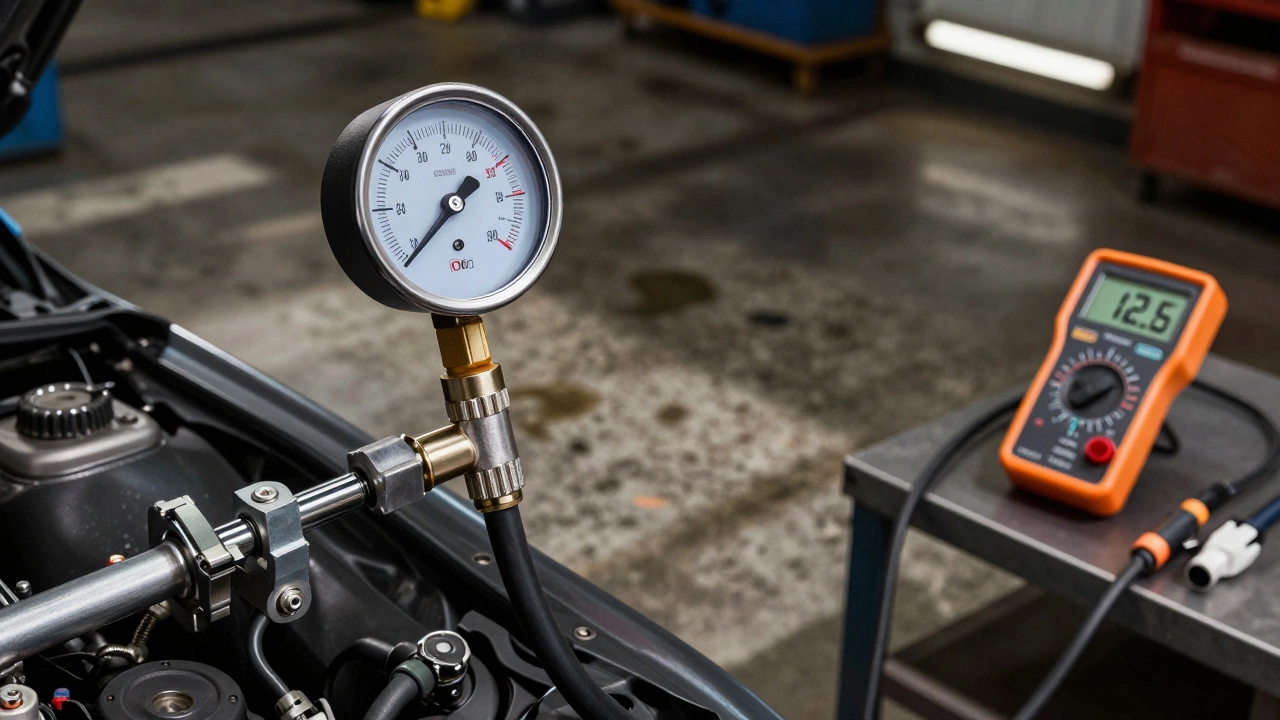
This is the most reliable way to confirm a weak fuel pump. You’ll need a fuel pressure test kit - they cost under $50 at auto parts stores. Most kits come with adapters for Schrader valves on the fuel rail (the metal tube that feeds fuel to the injectors).
Here’s how:
- Relieve fuel pressure: Disconnect the fuel pump fuse, then crank the engine for 10 seconds to drain residual pressure.
- Attach the gauge to the fuel rail’s test port. Use the right adapter - some cars need a special fitting.
- Turn the key to "on" (don’t start). The pump should prime and show pressure on the gauge.
- Start the engine. Watch the pressure while idling and under acceleration.
Typical pressure ranges:
- Gasoline cars: 30-60 psi (check your manual - some older models run as low as 25 psi)
- Direct injection: 50-100 psi
- Diesel: 100-300 psi
If pressure is below spec, especially under load, your pump is losing strength. If pressure drops when you rev the engine, that’s a classic sign of a failing pump. A healthy pump maintains pressure even under high demand.
Check for fuel flow
If you don’t have a pressure gauge, you can still test flow. Disconnect the fuel line at the engine side (after relieving pressure). Point it into a clean container. Turn the key to "on" - you should get a steady stream of fuel for 5-10 seconds. A weak trickle means low pressure. A dribble or no flow means the pump is dead or clogged.
Warning: This test is messy. Do it outside, away from sparks. Keep a fire extinguisher nearby. Gasoline vapors are dangerous.
Use a multimeter to check voltage
A fuel pump needs 12-13 volts to run properly. If it’s getting less, the problem isn’t the pump - it’s the power supply.
Here’s how to test:
- Locate the fuel pump connector - usually near the fuel tank or under the rear seat.
- Disconnect it and set your multimeter to DC voltage.
- Have someone turn the key to "on." Probe the two terminals on the connector.
- You should read 12-13 volts. Anything below 10 volts means a wiring issue - corroded connector, bad ground, or failing relay.
If voltage is good but the pump still doesn’t run, the pump itself is likely bad. If voltage is low, trace the wiring back to the fuse box. Look for frayed wires, melted insulation, or loose terminals. A bad ground connection is a common hidden culprit.
What a bad fuel pump sounds and feels like
Here are the real-world signs you’re not just imagining:
- Engine sputters at high speed - the pump can’t keep up with demand.
- Car stalls when hot - heat makes the pump’s internal components expand and fail temporarily.
- Loss of power under load - going uphill or accelerating feels sluggish.
- Whining noise from the tank - louder than the normal hum. That’s the pump struggling.
- Hard starts after sitting - the pump can’t build pressure fast enough.
These symptoms often get blamed on injectors or sensors. But if the fuel system isn’t delivering enough volume, nothing else will fix it.
Don’t ignore the fuel filter
A clogged fuel filter can mimic a bad pump. If the filter is old - especially if it hasn’t been changed in 40,000 miles or more - it’s restricting flow. Replace it before you replace the pump. It’s cheaper, easier, and might solve the problem.
Some cars have the filter inside the tank, built into the pump assembly. If that’s the case, you’ll need to replace the whole unit anyway. But if it’s external (common on older cars), swap it first. Save yourself time and money.
When to replace the fuel pump
If pressure is low, voltage is good, and you’ve ruled out the filter and wiring - it’s time to replace the pump. Don’t wait until it dies completely. A failing pump can overheat and damage the fuel tank or injectors.
When buying a replacement:
- Stick to OEM or reputable brands like Bosch, Denso, or Delphi.
- Avoid cheap no-name pumps - they often fail within months.
- Check the flow rate and pressure specs match your vehicle exactly.
Replacing the pump usually means dropping the fuel tank. It’s a messy job. Drain the tank to a quarter full first. Wear gloves. Use a siphon pump. And if you’re not comfortable, take it to a shop. A bad pump replacement done wrong can lead to fuel leaks - a serious fire risk.
Prevent future failures
Fuel pumps last longer when they’re kept cool and clean. Here’s how:
- Keep your tank at least a quarter full - running low makes the pump overheat. The fuel cools the pump. No fuel? No cooling.
- Use quality fuel - dirty gas clogs filters and wears out pump internals faster.
- Replace the fuel filter on schedule - even if it’s built into the pump.
- Avoid frequent short trips - short drives don’t let the fuel system warm up, letting moisture build up.
Most fuel pumps last 100,000-150,000 miles. But if you’ve been running on fumes, you might see failure at 60,000. Prevention isn’t glamorous - but it’s cheaper than a tow truck.
Can a fuel pump fail without warning?
Yes, but it’s rare. Most fuel pumps give signs - sputtering, hard starts, or whining noises - before they die completely. If your car suddenly won’t start and you hear no hum from the tank, that’s usually a total failure. Still, it’s better to test early than wait for it to strand you.
Can I drive with a failing fuel pump?
Technically yes, but you shouldn’t. A weak pump can cause engine misfires, damage the catalytic converter, or cause the engine to stall while driving. That’s dangerous on highways. It also puts extra stress on other parts. Replace it before it leaves you stranded.
How long does a fuel pump test take?
The whole process takes about 30-45 minutes if you have the tools. Listening for the hum takes 2 minutes. Checking the fuse and relay is 5 minutes. Testing pressure or flow takes another 20-30. Most of the time is spent finding the right parts and safely relieving pressure.
Is it cheaper to test the fuel pump or just replace it?
Testing is always cheaper. A fuel pressure gauge costs $40. A new pump costs $200-$600. If you’re unsure, test first. Many people replace pumps unnecessarily because they assume the problem is the pump. But 30% of the time, it’s a clogged filter, bad relay, or wiring issue.
Do electric fuel pumps wear out faster than mechanical ones?
Modern cars use electric pumps, and they’re more reliable than old mechanical ones - but they’re also more sensitive to dirty fuel and running low. Mechanical pumps, found in older cars, are simpler and last longer if maintained. But they’re not used in any cars made after the early 2000s. If you’re driving a modern vehicle, you’re dealing with an electric pump - and keeping your tank full is the #1 way to extend its life.