Exhaust Noise & Legality Simulator
Factory Stock System
The factory system is designed for balance. It uses baffles and chambers to cancel sound waves, keeping noise at conversational levels while maintaining efficiency.
There is a moment every car enthusiast dreads. You finally bolt on that new exhaust setup, fire up the engine, and realize you didn’t just get a sporty rumble. You got a jet engine in your living room. The question isn't really about which sounds cooler anymore; it's about which one will make your neighbors call the police before breakfast. When comparing a muffler delete is the removal of the muffler from an exhaust system while retaining the resonators and piping, it creates a loud, often harsh tone. A straight pipe is an exhaust configuration where all restrictive components like mufflers and catalytic converters are removed for maximum flow and volume. The short answer to "which is louder" is usually the straight pipe, but the reality is messier. It depends on your engine, your driving habits, and how much you value hearing your own thoughts.
The Physics of Exhaust Noise
To understand why these two modifications sound so different, we have to look at what they actually do. An exhaust system isn't just a tube to let gas out. It’s a carefully engineered acoustic dampener. Factory systems use baffles, chambers, and perforated tubes inside the muffler to cancel out sound waves through destructive interference. Think of it like noise-canceling headphones for your car.
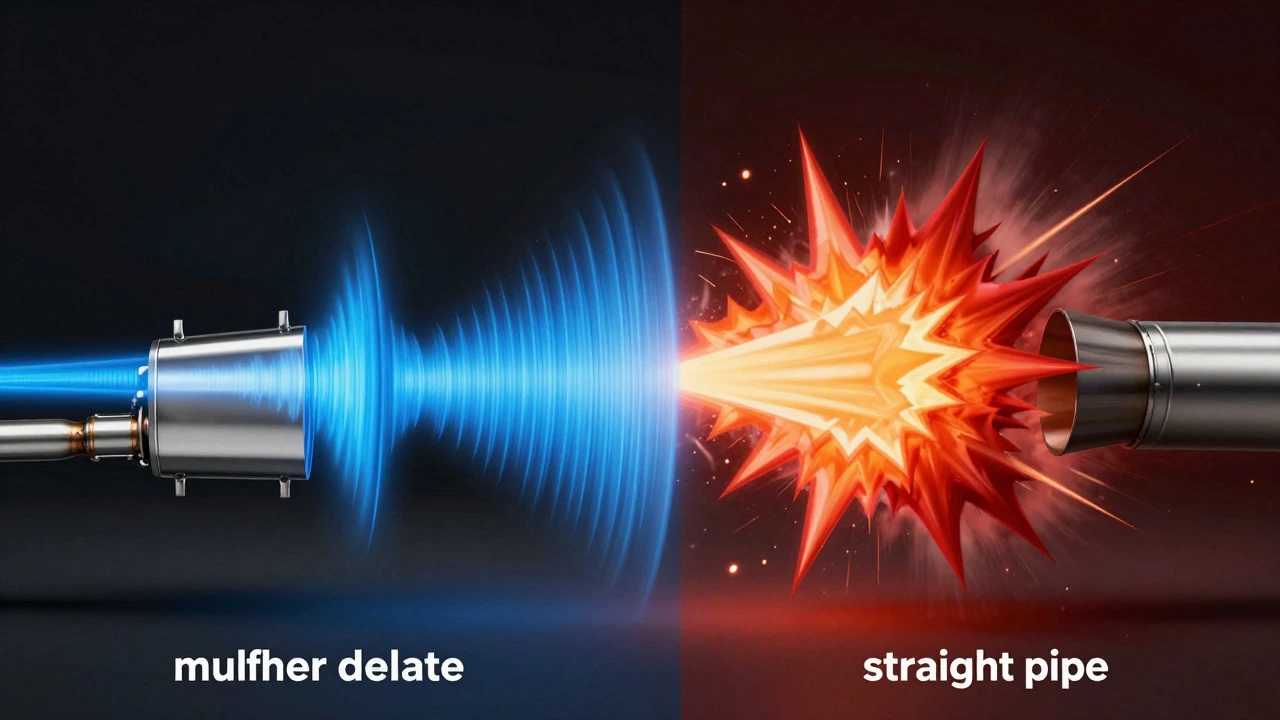
When you perform a muffler delete, you are removing the final stage of this cancellation process. However, most modern cars still have a resonator is a component in the exhaust system designed to cancel specific low-frequency frequencies. This means a muffler delete retains some acoustic tuning. The result is often a deeper, more aggressive tone at idle and cruise, but it can get surprisingly loud under hard acceleration. It’s not just volume; it’s character. You might hear a distinct "pop" or "crackle" on overrun because the primary sound-dampening device is gone.
A straight pipe changes the game entirely. By removing the muffler, the resonator, and often the catalytic converter (depending on local laws), you are left with a smooth, uninterrupted tube. There are no baffles to bounce sound off. No chambers to trap pressure. The exhaust gases exit the tailpipe at nearly the same speed and pressure they left the engine. This lack of restriction doesn't just increase horsepower slightly; it removes the physical barriers that keep noise down. The sound is raw, unfiltered, and consistently high-volume across the entire RPM range.
Decibel Levels: The Numbers Don't Lie
If you want concrete data, we have to talk about decibels (dB). Human perception of sound is logarithmic, meaning a small increase in dB feels like a massive jump in loudness. A factory exhaust typically sits between 70 and 85 dB at cruising speeds. That’s conversational volume.
| Exhaust Type | Idle Noise (dB) | Cruising Noise (dB) | Wide Open Throttle (dB) | Tone Character |
|---|---|---|---|---|
| Factory Stock | 60-70 | 70-85 | 90-100 | Muffled, refined |
| Muffler Delete | 75-85 | 85-95 | 105-115 | Buzzy, hollow, aggressive |
| Straight Pipe | 80-90 | 90-100 | 110-125+ | Raw, screaming, consistent |
Notice the gap at wide open throttle. While a muffler delete pushes past 100 dB, a straight pipe can easily exceed 115 dB. At 115 dB, you are entering the danger zone for hearing damage if exposed for prolonged periods. More importantly, many jurisdictions cap legal street noise at 80-85 dB. Both modifications likely violate these laws, but the straight pipe does so by a wider margin. If you live in an area with strict noise ordinances, like California or parts of Europe, a straight pipe is essentially a guarantee of a fine.
Performance Implications: Power vs. Pain
People don't just modify exhausts for noise; they do it for performance. The logic is simple: less backpressure equals better breathing for the engine. But does deleting the muffler or going straight pipe actually help?
For naturally aspirated engines, the gains from a muffler delete are negligible. You might see a tiny bump in horsepower at high RPMs because the engine doesn't have to push as hard against backpressure, but you’ll likely lose low-end torque. Why? Because backpressure isn't always bad. It helps maintain exhaust velocity, which is crucial for scavenging at lower RPMs. Without the muffler and resonator, the exhaust gases can become too diffuse, reducing efficiency when you’re just trying to merge onto the highway.
Straight piping offers slightly more flow potential, especially if you also remove the catalytic converter. High-performance builds with large displacement engines or forced induction (turbochargers or superchargers) benefit more from straight pipes. These engines move massive amounts of air, and any restriction hurts top-end power. However, for a daily driver, the loss in low-end torque often outweighs the high-RPM gains. You might feel sluggish in city traffic despite having a louder car.
Another factor is heat. Mufflers and resonators act as heat sinks. Removing them means more heat stays in the exhaust stream and radiates into the engine bay. This can raise under-hood temperatures, potentially affecting intake air density and overall engine efficiency. It’s a trade-off: you gain a few horsepower but risk overheating components during long drives.
Legal and Practical Considerations
Before you grab the angle grinder, consider the legal landscape. In the United States, emissions laws vary by state. Many states require vehicles to pass smog checks, which include visual inspections for catalytic converters. A straight pipe setup often involves removing the cat, which is illegal in 30+ states unless the car is designated for "off-highway use only." Even if you keep the cat, a straight pipe might fail inspection due to excessive noise.
Muffler deletes are sometimes viewed more leniently if the resonator remains intact, but enforcement varies. Police officers have discretion, and if your car sounds like a lawnmower, you’ll get pulled over. Beyond fines, there’s the issue of resale value. A straight-piped car is niche. Most buyers want a reliable daily driver, not a project that needs re-piping to be street-legal. You could struggle to sell the car or face significant depreciation.
Then there’s the human element. Your family, coworkers, and neighbors. A muffler delete might be annoying at first, but people adapt. A straight pipe is relentless. Imagine trying to have a conversation in your car at 60 mph. With a straight pipe, you’re shouting. Over time, this constant noise pollution can lead to driver fatigue and irritation. It’s not just about being loud; it’s about livability.

Alternatives: Getting Sound Without the Penalty
If you want a louder, more aggressive sound without the drawbacks of a muffler delete or straight pipe, consider aftermarket performance exhausts. Brands like Borla, MagnaFlow, and Flowmaster offer systems that replace the entire exhaust from the manifold back. These systems use larger diameter pipes and tuned mufflers to reduce backpressure while maintaining acceptable noise levels.
A cat-back exhaust system replaces everything from the catalytic converter backward. It allows for better flow than stock but includes a muffler designed for a specific tone. You can choose between options like "Sport," "Aggressive," or "Quiet" depending on the brand. This gives you control over the sound profile. You get the deep rumble and improved performance without the drone or excessive volume of a straight pipe.
Another option is a resonator delete kit. Some manufacturers sell kits that remove the resonator but keep the muffler. This adds a bit more bark to the exhaust note without going fully silent-free. It’s a middle ground that balances legality, comfort, and aggression.
Conclusion: Making the Right Choice
So, which is louder? The straight pipe wins hands down. It’s rawer, louder, and more consistent across all RPMs. But is it better? Probably not for most drivers. The muffler delete offers a compromise: significantly louder than stock, with a more aggressive tone, but still retaining some acoustic damping from the resonator. It’s less likely to cause immediate neighbor complaints or fail noise inspections compared to a full straight pipe.
Your choice should depend on your goals. If you’re building a track-only car where weight savings and maximum flow matter, go straight pipe. If you want a daily driver that sounds mean but doesn’t drive everyone crazy, stick with a quality aftermarket cat-back or a muffler delete with a retained resonator. Remember, loud isn’t always good. Sometimes, the best exhaust note is one that turns heads without turning ears off.
Is a straight pipe louder than a muffler delete?
Yes, a straight pipe is generally louder than a muffler delete. A straight pipe removes all sound-dampening components, including the muffler, resonator, and often the catalytic converter. This results in a raw, unfiltered exhaust note that is consistently loud across all RPMs. A muffler delete only removes the muffler, leaving the resonator to dampen some frequencies, resulting in a slightly quieter and more toned-down sound.
Will a muffler delete void my warranty?
It can. Under the Magnuson-Moss Warranty Act in the US, manufacturers must prove that the modification caused the damage to deny warranty coverage. However, removing the muffler can affect emissions sensors and exhaust temperature readings. If your engine fails due to heat-related issues or sensor errors linked to the exhaust change, the dealer may deny coverage. Always check with your manufacturer first.
Does a straight pipe increase horsepower?
Slightly, but mostly at high RPMs. A straight pipe reduces backpressure, allowing the engine to breathe easier. For naturally aspirated engines, the gain is minimal (1-3 HP). For turbocharged or high-performance engines, the gain can be more noticeable (5-10 HP). However, you may lose low-end torque, making the car feel sluggish in everyday driving conditions.
Is it illegal to straight pipe a car in 2026?
In many places, yes. Most US states have noise ordinances and emissions laws. Straight piping often involves removing the catalytic converter, which is illegal in 30+ states for street-driven vehicles. Even if you keep the cat, the excessive noise can lead to fines. Check your local DMV regulations and EPA guidelines before modifying your exhaust.
What is the difference between a resonator and a muffler?
A muffler reduces overall volume using baffles and chambers to cancel sound waves. A resonator targets specific frequencies, usually low-frequency drones, to refine the exhaust tone. Resonators are smaller and located closer to the engine. Deleting the muffler makes the car louder, while deleting the resonator changes the pitch and character of the sound.
Can I put a straight pipe on a diesel truck?
Technically yes, but it’s complex. Diesel trucks often have Diesel Particulate Filters (DPF) and Exhaust Gas Recirculation (EGR) systems. Straight piping requires deleting these components, which triggers warning lights and may require a tuner to disable emissions controls. This is illegal for street use in most regions and can lead to expensive repairs if the engine goes into limp mode.
How much does a muffler delete cost?
A DIY muffler delete costs $0-$50 for tools and clamps. Professional installation ranges from $100-$300. Aftermarket replacement pipes that mimic a delete but are cleaner look cost $100-$400. Straight pipe kits vary widely, from $150 for basic tubing to $1,000+ for polished stainless steel systems.