Oil Quantity Calculator
Follow These Steps Safely
When your dipstick shows dry, never fill the entire capacity at once. Start with half a quart and check repeatedly. Overfilling causes damage like foaming, overheating, and seal failure.
- 1. Check your owner's manual for exact oil capacity
- 2. Start with 0.5 quarts (470ml)
- 3. Wait 2 minutes for oil to settle
- 4. Recheck dipstick - repeat until you see oil
- 5. Stop at MIN mark - do NOT exceed MAX
Oil Level Progress
Current Oil Level: 0 quarts
Critical Safety Notes
- Do NOT fill above MAX mark - causes foaming and damage
- Always check after 2 minutes of settling
- Never drive with dry dipstick - engine damage occurs within minutes
- Stop adding oil when oil appears on dipstick
If your dipstick comes out completely dry, you’re not just low on oil-you’re running on empty. That’s not a warning light. That’s a red flag waving in your engine’s face. Running without enough oil can turn your engine from a reliable machine into a melted mess in minutes. So what do you do? How much oil should you add? And more importantly, how do you do it without making things worse?
Don’t panic-yet
A dry dipstick doesn’t mean your engine is already dead. But it does mean you’ve got a serious problem. Most engines hold between 4 and 7 quarts of oil. If the dipstick shows zero, you’re likely missing at least 3 to 5 quarts. That’s not a top-off. That’s a refill from near-empty.
Before you pour anything in, stop the car. Turn off the engine. Let it sit for at least 5 minutes. Oil needs time to drain back into the pan. If you check right after driving, oil can still be clinging to the cylinder walls or sitting in the upper parts of the engine. You’ll get a false reading. Wait. It’s that simple.
Check the owner’s manual
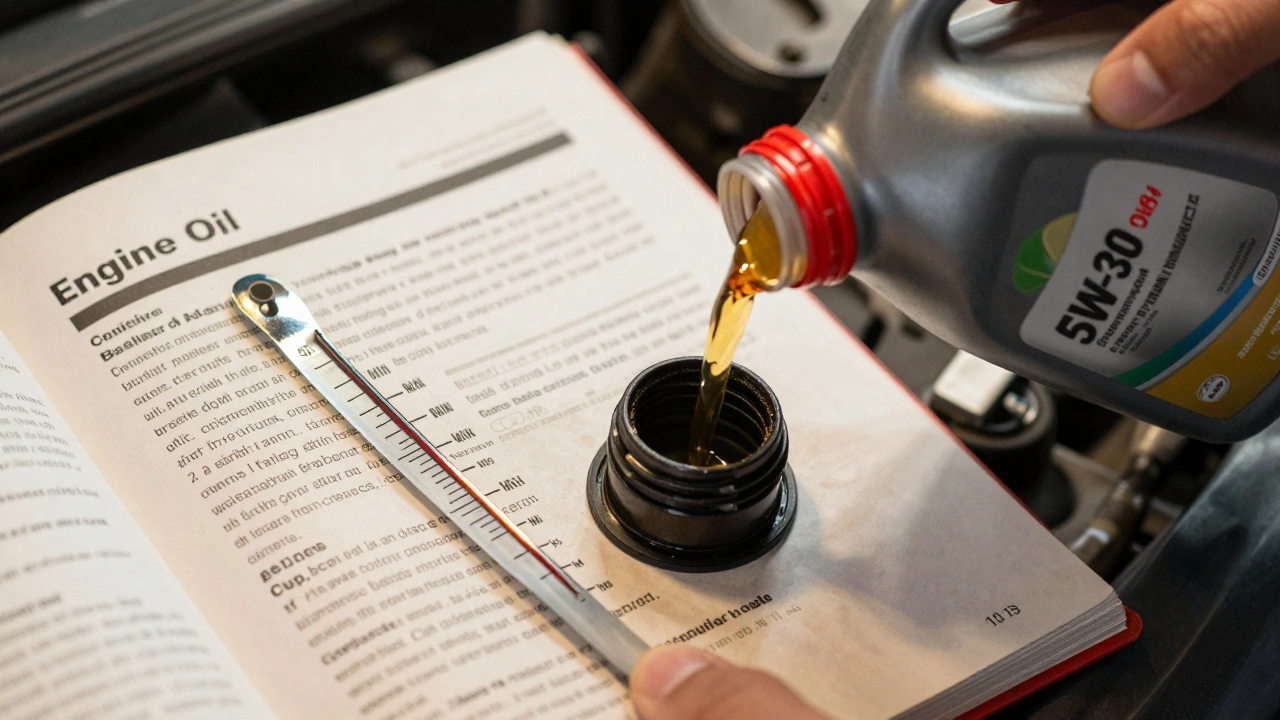
Not all cars are built the same. A compact hatchback might need 4 quarts. A V6 SUV might need 6.5. A diesel truck? Could be over 8. The only way to know for sure is to check your owner’s manual. Look for the section labeled “Engine Oil” or “Maintenance.” It’ll list the exact capacity and the recommended oil type-5W-30, 10W-40, synthetic, etc.
Don’t guess. Don’t assume your neighbor’s car uses the same oil as yours. Mixing wrong types or adding too much can cause damage. Overfilling is just as dangerous as being underfilled. Too much oil creates foam, which the oil pump can’t handle. That leads to poor lubrication, overheating, and even oil leaks from seals.
Start with half a quart
When the dipstick is bone dry, don’t dump in a full quart right away. Start with half a quart (about 470 ml). Then wait 2 minutes for it to settle. Pull the dipstick again. Wipe it clean. Reinsert it fully. Pull it out.
If it still reads dry, add another half quart. Repeat until you see oil on the dipstick. You’re not aiming for “full” yet. You’re aiming for “at least the minimum mark.” That’s the bottom line on the dipstick-usually marked with a hole, a line, or the word “MIN.”
Once you hit the minimum, stop. You can top up to the full mark later. But if you overshoot, you’ll have to drain it out. And that’s messy.
Why you shouldn’t just fill to the top
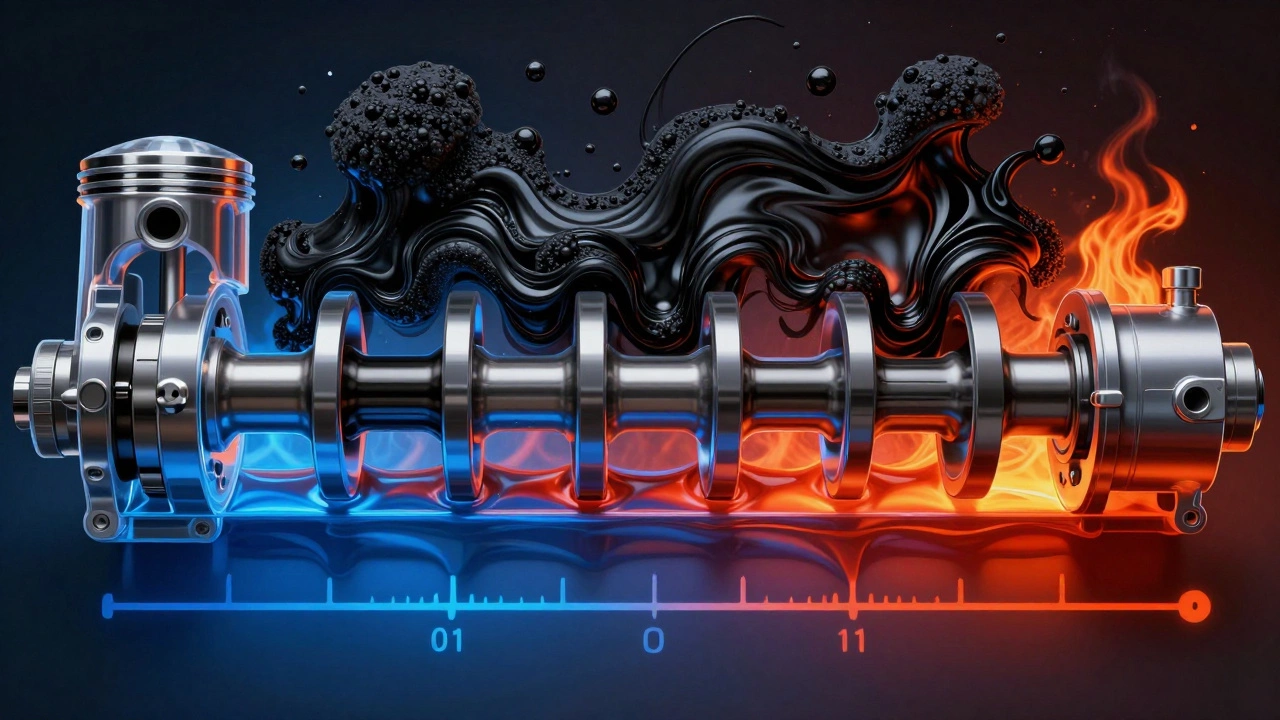
Some people think, “If it’s dry, I’ll just pour in the whole can.” That’s a mistake. Engines are designed to operate with a specific oil volume. Too much oil creates pressure inside the crankcase. The oil gets whipped into foam by the spinning crankshaft. Foam doesn’t lubricate. It insulates. That leads to overheating.
Excess oil can also get sucked into the PCV system, clog the catalytic converter, or even leak past seals and gaskets. I’ve seen engines with blown valve cover gaskets because someone poured in 8 quarts when the manual said 6. It wasn’t a leak-it was a flood.
What to look for on the dipstick
Not all dipsticks are created equal. Some have two marks: “MIN” and “MAX.” Others have a crosshatch area. The oil level should be between those lines. If it’s below MIN, you’re in danger. If it’s above MAX, you’re risking damage.
Also, check the color and texture. If the oil looks milky, it’s mixed with coolant-your head gasket might be blown. If it’s thick, black, and gritty, it’s overdue for a change. If it smells like gasoline, you’ve got a fuel leak into the oil. That’s serious. Don’t drive. Call a mechanic.
What kind of oil to use
Never use just any oil. Your engine was designed for a specific viscosity and formulation. Look at the cap on your oil filler neck. It’ll say something like “5W-30” or “0W-20.” Use that. If you’re unsure, check the manual. Synthetic oil lasts longer and flows better in cold weather. Conventional oil is cheaper but breaks down faster.
Don’t mix synthetic and conventional unless it’s an emergency. And never use diesel oil in a gasoline engine-or vice versa. The additives are different. Diesel oil has more detergents. Gasoline oil has more anti-wear agents. They’re not interchangeable.
What to do after adding oil
Once you’ve added enough to reach the minimum mark, start the engine. Let it idle for 30 seconds. Then turn it off again. Wait 2 minutes. Check the dipstick one more time. If it’s still low, add another quarter quart. Repeat until you’re within the safe zone.
Now, drive the car for 10 minutes-no highway speeds, just around the block. Then park on level ground. Check again. If the level dropped, you’ve got a leak. Look under the car. Check the oil filter. Check the drain plug. Look for drips or stains. If you see any, don’t keep driving. Get it towed.
Why your dipstick went dry
Oil doesn’t just vanish. If you’re low, something’s wrong. Here are the most common reasons:
- Leak: A loose oil filter, cracked pan, or worn seal. Look for dark spots under the car.
- Consumption: Older engines burn oil. If you’re adding a quart every 1,000 miles, that’s normal for a high-mileage car. If you’re adding a quart every 500, something’s failing.
- Blown head gasket: Oil and coolant mixing. Milky oil. White smoke from the exhaust. That’s a major repair.
- Forgotten oil change: You didn’t realize you were overdue. This happens more than you think.
If you’re unsure why it happened, don’t guess. Get the car checked. A dry dipstick is a symptom. The real problem might be hiding underneath.
Prevent it from happening again
Check your oil every time you fill up. That’s about every 300 to 400 miles. It takes 30 seconds. You’ll catch problems early. Most people wait until something breaks. Don’t be one of them.
Keep a quart of the right oil in your trunk. Not everyone has a mechanic on speed dial. Having a spare quart means you can fix a dry dipstick before it becomes a tow truck bill.
And if your car is older than 10 years or has over 100,000 miles, consider switching to a high-mileage oil. It has extra seal conditioners to reduce leaks and better detergents to keep sludge down.
When to call a professional
You can add oil yourself. You can’t rebuild an engine. If you’ve added oil and the engine still makes knocking or ticking noises, shut it off. Don’t restart it. That’s metal-on-metal. That’s damage in progress.
If the oil light stays on after you’ve topped up, that’s not a sensor glitch. That’s a pressure problem. It could be a failed oil pump, clogged pickup tube, or a worn bearing. Those aren’t DIY fixes.
And if you smell burning oil or see smoke from the engine bay, get out of the car. Call for help. That’s not a maintenance issue. That’s a fire risk.
Can I drive my car if the dipstick is dry?
No. Driving with no oil will destroy your engine within minutes. Even a few seconds of running without lubrication can score the cylinder walls, seize pistons, or melt bearings. If you notice a dry dipstick, stop immediately. Turn off the engine. Do not attempt to drive it anywhere.
How often should I check my engine oil?
Check your oil at least once a month, and always before a long trip. If your car is older than 8 years or has over 75,000 miles, check it every time you fill the gas tank. High-mileage engines burn more oil, and catching low levels early prevents catastrophic failure.
What happens if I add too much oil?
Too much oil creates foam inside the crankcase, which the oil pump can’t circulate properly. This leads to poor lubrication, overheating, and increased pressure that can blow out seals or gaskets. You might also see smoke from the exhaust as excess oil burns in the combustion chamber. Always fill to the “MAX” line-not above it.
Can I use any type of oil to top up?
Only if it matches the viscosity and specification listed in your owner’s manual. For example, if your car requires 5W-30 synthetic, topping up with 10W-40 conventional oil can cause poor cold-start performance and reduce engine protection. Mixing types isn’t ideal, but in an emergency, it’s better than running dry. Change the oil as soon as possible after.
Why does my dipstick show dry even after adding oil?
If you added oil but the dipstick still reads dry, you may have added it too quickly. Oil takes time to flow down into the oil pan. Wait 5 minutes after adding, then recheck. If it’s still dry, you likely have a major leak. Look under the car for drips or stains. If none are visible, the oil may be burning or being consumed internally-get it inspected.