Car Starting Issue Diagnostic Tool
Symptom Checker
Select symptoms you're experiencing to determine if bad spark plugs might be the cause.
Diagnostic Results
If your car turns over but won’t start, and you’ve checked the battery and fuel, the problem might be hiding in plain sight-your spark plugs. They’re small, cheap, and often ignored until your engine refuses to fire. But yes, bad spark plugs can absolutely cause a car to not start. Not every time, not always, but often enough that skipping their replacement is one of the dumbest mistakes a car owner can make.
How Spark Plugs Actually Work
Every engine relies on a tiny explosion to move the car. That explosion happens inside the cylinder, where air and fuel mix. But air and fuel won’t ignite on their own. You need a spark. That’s where the spark plug comes in. It sits right in the top of the cylinder, with one end connected to the ignition coil and the other sticking into the combustion chamber. When the coil sends a high-voltage pulse, the plug fires a spark across a small gap-about the width of a paperclip-and ignites the fuel. That’s it. Simple. But if that spark doesn’t happen, the engine won’t run.
Modern spark plugs last 30,000 to 100,000 miles depending on type. Copper plugs wear out faster. Platinum and iridium ones last longer. But even the best ones don’t last forever. Over time, the electrode wears down. Carbon builds up. The gap widens. The spark gets weaker. Eventually, it stops firing altogether.
Signs Your Spark Plugs Are Failing
Bad spark plugs don’t always kill the engine dead. Sometimes they just make it sick. Here’s what you might notice before it gets to the point of no start:
- Engine misfires-especially under acceleration or uphill
- Rough idle, like the car is shuddering when stopped
- Sluggish acceleration, like the engine is struggling to catch up
- Increased fuel consumption-you’re filling up more often for no reason
- Check engine light comes on with codes like P0300 (random misfire) or P0301-P0308 (cylinder-specific misfire)
These aren’t just annoyances. They’re warnings. Misfires mean unburned fuel is washing down the cylinder walls, diluting your oil. That can ruin your engine over time. And if the misfires get bad enough, the engine control unit will stop trying to fire the bad cylinders. That’s when your car goes from running rough to not starting at all.
Why a Bad Spark Plug Can Stop a Car from Starting
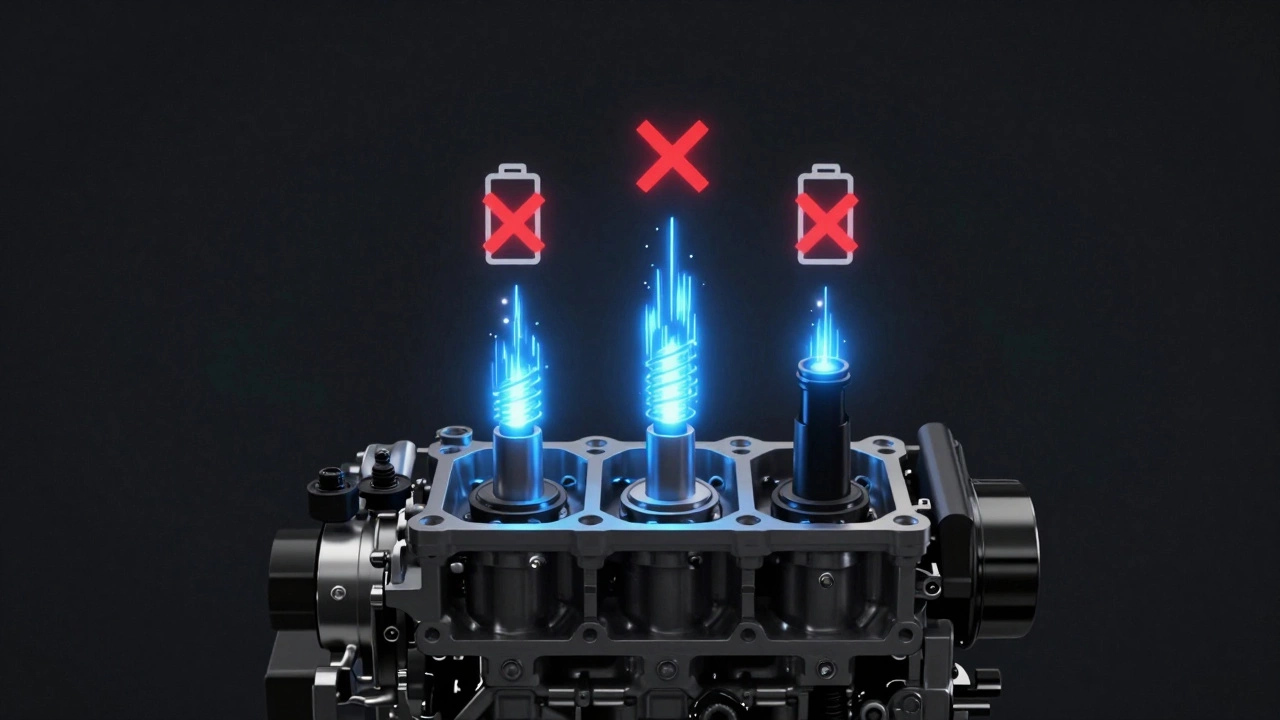
Imagine your engine has four cylinders. If one spark plug fails, the car might still run-just poorly. But if two or three go bad? The engine loses too much power to turn over properly. It might crank, but it won’t fire. No combustion means no movement. No movement means no start.
Worn electrodes can’t jump the gap. Carbon buildup can short-circuit the spark. Oil leaks into the cylinder (often from bad valve seals) can coat the plug and drown the spark. Even moisture from a wet garage or heavy rain can cause a spark plug to misfire temporarily-especially if the insulation is cracked.
Here’s the real kicker: a car that won’t start because of spark plugs often looks like it has a dead battery. It turns over, but no fire. People replace batteries, then alternators, then fuel pumps-spending hundreds-when all they needed was a $20 set of spark plugs.
What Happens When You Try to Start a Car with Bad Spark Plugs
You turn the key. The starter motor spins the engine. You hear the familiar whirrrr-whirrrr. But no cough. No sputter. No start. That’s because the fuel is there. The air is there. The battery has juice. But without a spark, nothing ignites.
Some people think the engine should at least backfire or pop. It might-if the fuel is pooling and then igniting in the exhaust. But that’s rare. More often, the engine just sits there, silent and stubborn. The car’s computer might even shut down fuel delivery after a few failed start attempts to protect the catalytic converter from flooding.
Try this: smell the exhaust pipe after a few failed starts. If you smell raw gasoline, that’s a clue. Fuel is being sprayed into the cylinders, but it’s not burning. That’s a classic sign of spark plug failure.
How to Check Spark Plugs Yourself
You don’t need a mechanic to check your spark plugs. Here’s how to do it in under 30 minutes:
- Let the engine cool. Hot engines can burn you.
- Remove the ignition coils or spark plug wires. Label them so you put them back in the right order.
- Use a spark plug socket and ratchet to unscrew each plug. Don’t force it.
- Look at the tip. A healthy plug has a light brown or grayish color. Black, oily, or white deposits mean trouble.
- Check the gap. Use a feeler gauge. Most modern plugs need 0.028 to 0.032 inches. If it’s wider than 0.040, it’s worn out.
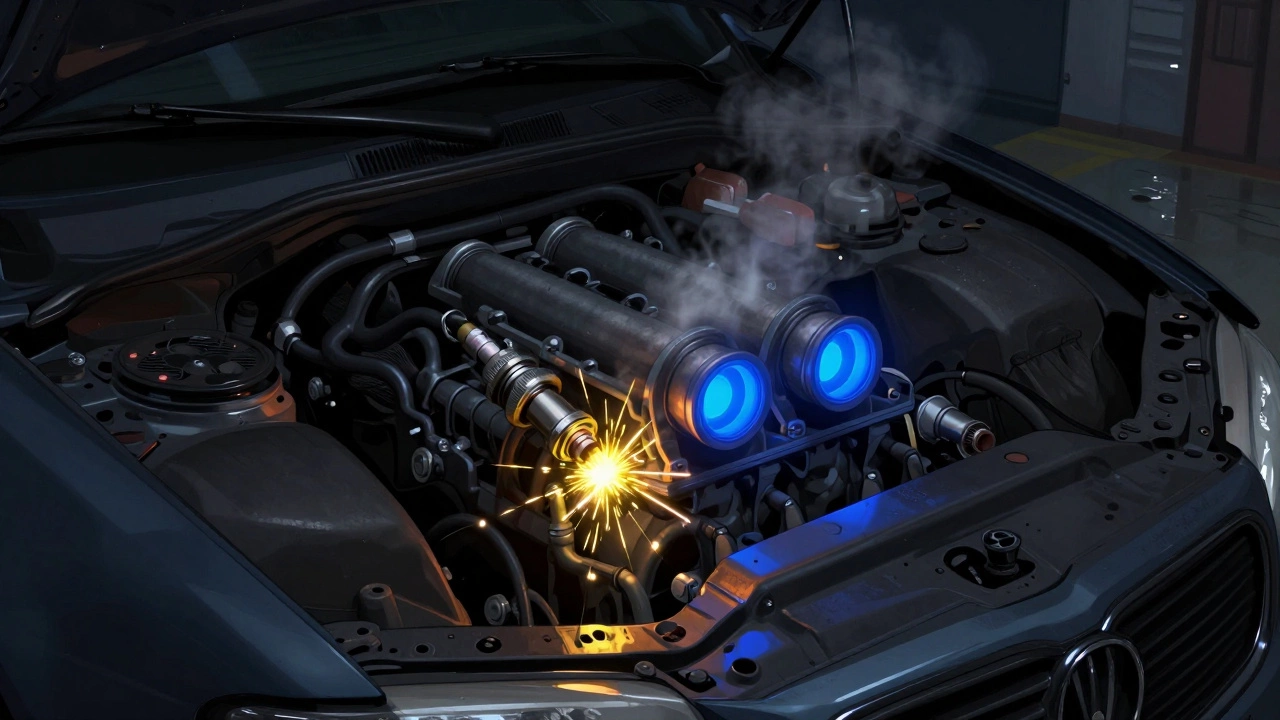
- Do a spark test: reconnect one plug to its wire, lay it on the engine block (not touching metal), and have someone crank the engine. You should see a bright blue spark. Yellow or no spark? Replace it.
Even if one plug looks fine, replace them all. They wear together. Mixing old and new plugs creates uneven firing, which hurts performance.
What to Replace Them With
Not all spark plugs are equal. Stick to what your owner’s manual says. If it calls for iridium, don’t swap in copper just to save money. Iridium lasts longer and fires hotter. Copper is cheaper but wears out in 20,000 miles. Platinum is in the middle.
Brands matter too. NGK, Denso, Bosch, and Champion are reliable. Avoid no-name brands from discount stores. I’ve seen cheap plugs misfire after 5,000 miles-costing more in fuel and stress than the savings.
Other Things That Can Mimic Bad Spark Plugs
Before you blame the plugs, rule out other common causes:
- Dead battery-even if the starter turns, weak voltage can prevent spark
- Faulty ignition coil-each coil feeds one or more plugs
- Bad fuel pump or clogged filter-no fuel, no start
- Broken timing belt-won’t let the valves open in sync
- Faulty crankshaft sensor-tells the computer when to fire the spark
If you’ve replaced the spark plugs and the car still won’t start, check these next. But if the plugs were black and gapped wide? You’ve found your problem.
How Often Should You Replace Spark Plugs?
Most manufacturers say 60,000 to 100,000 miles. But that’s under perfect conditions. In real life? If you drive short trips, sit in traffic, or use low-quality fuel, your plugs wear faster. I’ve seen cars in Bristol with 40,000-mile plugs that were dead because they never got hot enough to burn off carbon.
Here’s my rule: replace them every 40,000 miles if you drive in stop-and-go traffic. Every 60,000 if you mostly do highway miles. And always replace them if you’re having trouble starting the car in cold weather.
Spring and autumn are good times to do it. Not because of the weather-but because you’ll notice performance improvements right away. Better fuel economy. Smoother idle. Easier starts.
What Happens If You Ignore Bad Spark Plugs?
Ignoring them doesn’t just mean you’ll be stranded. It can cost you thousands.
Unburned fuel washes oil off the cylinder walls. That leads to increased engine wear. It can also flood the catalytic converter, which costs £1,000+ to replace. Misfires can crack the exhaust manifold. Oil leaks can ruin the valve seals. All of it adds up.
And in cold weather? A car with bad spark plugs won’t start at all. Not even after ten tries. You’ll be standing outside in the rain, wondering why your car won’t turn over-when all you needed was a $50 fix.
Final Verdict
Yes, bad spark plugs can cause a car to not start. Not always. But often enough that it should be the first thing you check after ruling out the battery. They’re cheap. Easy to replace. And if you ignore them, you’re gambling with your engine’s life.
Next time your car cranks but won’t fire, don’t panic. Don’t call a tow truck. Get under the hood. Pull a plug. Look at it. Test it. You might just save yourself a day of hassle-and a few hundred pounds.