Spark Plug Health Checker
Symptom Analysis
Select symptoms you're experiencing to determine if bad spark plugs are likely the cause.
Results
Please select at least one symptom to get results.
If your car is sputtering, struggling to start, or losing power on the highway, it might not be your fuel pump or battery-it could be your spark plugs. These small, cheap parts are responsible for igniting the air-fuel mixture in your engine. When they go bad, your engine doesn’t just run poorly-it can start costing you money in fuel, repairs, and even emissions. Most drivers don’t think about spark plugs until something goes wrong. But knowing the early signs can save you from bigger problems down the road.
Your engine misfires or runs rough
One of the clearest signs of worn spark plugs is an engine that misfires. You’ll feel it as a sudden jerk or stumble, especially when accelerating from a stop or climbing a hill. It’s not just a slight hiccup-it’s a full-blown stutter. Misfires happen because the spark plug isn’t delivering a strong enough spark to ignite the fuel properly. The result? Unburned fuel gets pushed out through the exhaust, which can damage your catalytic converter over time.
Modern cars will often turn on the check engine light and store a code like P0300 (random misfire) or P0301-P0308 (cylinder-specific misfires). But even if the light doesn’t come on, you’ll still feel the difference. If your car feels like it’s dragging its feet when you press the gas, bad spark plugs are a likely culprit.
Hard starting or no start at all
Remember when your car started with one turn of the key? Now it takes two, three, or even four tries just to turn over? That’s not normal. Worn or fouled spark plugs struggle to ignite the fuel mixture, especially in cold weather. If you’re cranking the engine and it just won’t catch, even with a fully charged battery, it’s time to check the spark plugs.
Old, cracked, or carbon-coated plugs lose their ability to jump the gap. The spark becomes weak or inconsistent. In extreme cases, the engine won’t start at all. This isn’t just inconvenient-it’s dangerous if you’re stranded in the rain or at night. Don’t wait until you’re stuck on the side of the road to replace them.
Rough idle
When your car is parked and the engine is running, it should be smooth. If you notice the engine shaking, vibrating, or dropping RPMs noticeably, your spark plugs could be to blame. A rough idle happens because one or more cylinders aren’t firing correctly. The engine doesn’t have the balance it needs to run steadily.
You might feel the vibration through the steering wheel or seat. Sometimes, the RPM needle bounces between 500 and 800 instead of staying steady at 750. This isn’t just annoying-it means your engine is burning fuel inefficiently and putting extra stress on components like the mounts and transmission.
Decreased fuel efficiency
If you’ve noticed your gas tank empties faster than usual, and you haven’t changed your driving habits, bad spark plugs are probably why. When spark plugs fail, the fuel doesn’t burn completely. That means more fuel goes out the tailpipe instead of powering your wheels.
Studies from the U.S. Department of Energy show that worn spark plugs can reduce fuel economy by up to 30%. That’s not a small drop-it could mean paying an extra £50 a month at the pump if you drive 1,000 miles monthly. Replacing old plugs is one of the cheapest fixes you can make to get your mileage back.

Sluggish acceleration
When you press the gas pedal, your car should respond immediately. If it feels like there’s a delay-like the engine is thinking before it moves-you’re dealing with weak ignition. Bad spark plugs cause hesitation and lag during acceleration. You might find yourself downshifting more often just to get the same performance.
This isn’t just frustrating-it’s unsafe. Imagine merging onto a highway and your car doesn’t pick up speed when you need it. Or trying to pass another vehicle on a two-lane road and the engine stumbles. That hesitation could put you in danger. Spark plugs that are past their prime can’t deliver the quick, consistent sparks needed for responsive power delivery.
Increased emissions and failed emissions tests
Bad spark plugs don’t just hurt your wallet-they hurt the environment. Incomplete combustion leads to higher levels of hydrocarbons and carbon monoxide in your exhaust. Many places require emissions testing to renew your registration. If your car fails because of high emissions, it’s often because of worn spark plugs.
Even if your area doesn’t require testing, the smell of unburned fuel coming from the tailpipe is a dead giveaway. That’s not just an odor-it’s pollution. Replacing spark plugs regularly helps your car run cleaner and meet environmental standards without expensive repairs.
Engine knocking or pinging
That metallic tapping or pinging sound you hear under load? That’s detonation-or engine knock. It happens when fuel ignites at the wrong time due to inconsistent spark timing. Bad spark plugs can cause the air-fuel mixture to ignite too early or unevenly, leading to pressure waves that crash into the piston.
Engine knock isn’t just loud-it’s destructive. Left unchecked, it can crack pistons, damage valves, or even ruin the head gasket. If you hear this sound, especially when accelerating or climbing hills, don’t ignore it. It’s often the first warning sign that your ignition system is failing.
When to replace spark plugs
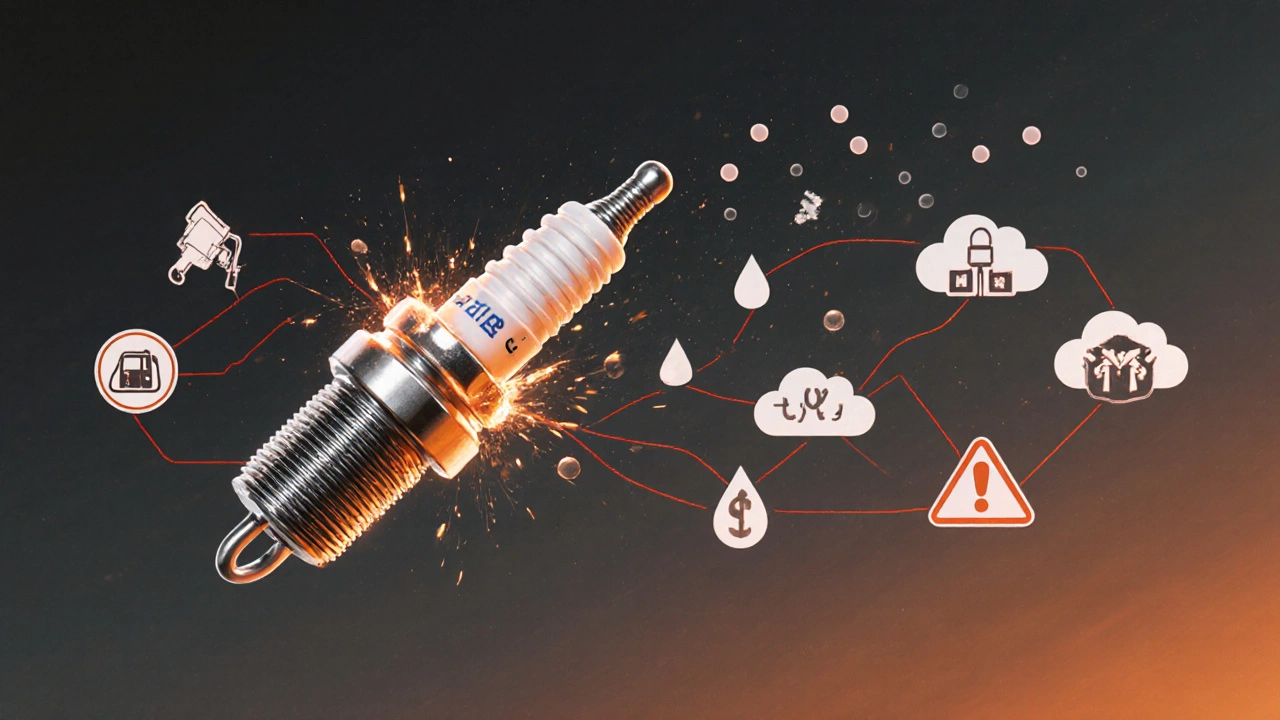
Most manufacturers recommend replacing spark plugs every 30,000 to 100,000 miles, depending on the type. Standard copper plugs last about 30,000 miles. Platinum ones can go 60,000-100,000 miles. Iridium plugs-the most durable-often last up to 120,000 miles.
But mileage isn’t the only factor. If you drive short trips often, your plugs will foul faster because the engine never reaches full operating temperature. If you use low-quality fuel or have an oil leak, carbon buildup will shorten their life. Don’t wait for the manual’s schedule if you’re already seeing symptoms.
What happens if you ignore bad spark plugs
Ignoring worn spark plugs doesn’t just mean poor performance-it can trigger a chain reaction of damage. Unburned fuel washes down the cylinder walls, diluting your engine oil. That reduces lubrication and increases wear on pistons and rings.
Over time, the catalytic converter can overheat from excess fuel, leading to melting or clogging. Replacing a catalytic converter costs £800-£1,500. Spark plugs cost £10-£50 each. That’s a massive difference.
And if your engine misfires for long enough, it can damage the oxygen sensors. Those are expensive to replace too. Simple maintenance saves you thousands.
How to check your spark plugs
You don’t need to be a mechanic to inspect them. Remove one plug with a socket wrench and look at the tip. A healthy plug has a light brown or grayish color. If it’s black and sooty, you’ve got carbon buildup. If it’s white or blistered, it’s overheating. If there’s oil on the threads, you’ve got a valve seal or piston ring leak.
Check the gap too. Use a wire feeler gauge. If the gap is too wide or uneven, the spark won’t jump properly. Even if the plug looks okay, if it’s been over 60,000 miles since replacement, it’s time to swap them out.
Replace all spark plugs at the same time. Mixing old and new ones creates imbalance. Always use the type specified in your owner’s manual. Don’t try to save money with cheap, no-name brands. Quality matters here.
| Symptom | Most Likely Cause | What to Do |
|---|---|---|
| Engine misfires | Worn electrodes, carbon buildup | Replace all spark plugs |
| Hard starting | Fouled or cracked insulator | Inspect and replace; check for oil leaks |
| Rough idle | Weak or inconsistent spark | Replace plugs and check ignition coils |
| Low fuel economy | Incomplete combustion | Replace plugs; monitor fuel trim readings |
| Engine knocking | Incorrect spark timing | Replace plugs immediately; check for overheating |
| High emissions | Unburned fuel in exhaust | Replace plugs; test oxygen sensors |
Final thoughts
Spark plugs are one of the most overlooked parts in a car. But they’re also one of the most critical. They’re cheap, easy to replace, and their failure can cost you far more than the repair itself. If your car is acting up-hesitating, shaking, struggling to start-it’s not always the battery, the fuel pump, or the air filter. Nine times out of ten, it’s the spark plugs.
Don’t wait for a breakdown. If you’ve passed 60,000 miles since your last replacement, or if you’re seeing any of these symptoms, get them checked. A quick inspection could save you hundreds-or even thousands-in preventable damage.
Can bad spark plugs cause a car to stall?
Yes, bad spark plugs can cause a car to stall, especially at idle or during low-speed driving. If the spark is too weak to ignite the fuel consistently, the engine can lose power suddenly and shut off. This is common in older cars with worn plugs or when moisture gets into the ignition system.
How often should I replace my spark plugs?
Most cars need new spark plugs every 30,000 to 100,000 miles, depending on the type. Copper plugs last 30,000-40,000 miles, platinum around 60,000-80,000, and iridium can go up to 120,000. Always check your owner’s manual. If you drive mostly short trips, replace them sooner-carbon builds up faster when the engine doesn’t fully warm up.
Can I drive with a bad spark plug?
You can drive for a short time, but it’s not safe or smart. A single bad plug can cause misfires, which damage the catalytic converter and increase emissions. It also strains the engine and reduces fuel efficiency. If you notice symptoms like rough idle or hesitation, replace the plugs as soon as possible to avoid costly repairs.
Do spark plugs affect acceleration?
Absolutely. Weak or inconsistent sparks cause lag in acceleration. The engine doesn’t get the full power it should from each combustion cycle. You’ll feel hesitation when pressing the gas pedal, especially when merging or passing. New spark plugs restore that immediate response.
Can bad spark plugs trigger the check engine light?
Yes, bad spark plugs are one of the most common reasons the check engine light comes on. Codes like P0300 (random misfire) or P0301-P0308 (cylinder-specific misfires) point directly to ignition problems. Even if the light turns off, the issue might still be there-don’t ignore it.