Suspension Problem Checker
Answer the questions below to identify potential suspension issues. This tool analyzes symptoms based on information from the article. If you're unsure or see critical warnings, consult a professional mechanic.
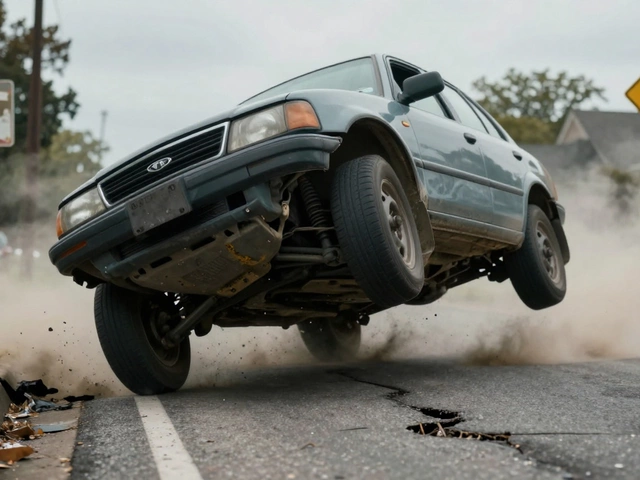
When your car feels like it’s bouncing over every pebble, or the steering wobbles when you hit a bump, your suspension is screaming for help. A bad suspension isn’t just uncomfortable-it’s dangerous. It affects braking, steering, and tire wear. If you’ve noticed any of these signs, you’re not imagining things. Fixing it isn’t rocket science, but it does need the right tools, safety steps, and a clear plan.
What Does a Bad Suspension Actually Feel Like?
Most people think a noisy ride means worn shocks. It’s not that simple. A failing suspension shows up in multiple ways:
- Excessive bouncing after hitting a bump-your car keeps going up and down like a pogo stick
- One corner of the car sitting lower than the others
- Steering that feels loose or wanders side to side
- Uneven tire wear, especially on the inside or outside edges
- A nose dive when braking hard
- Clunking or knocking sounds over rough roads
These aren’t minor annoyances. They’re warning signs. The National Highway Traffic Safety Administration found that vehicles with degraded suspension systems are 23% more likely to lose control during emergency maneuvers. That’s not a risk worth taking.
What Parts Make Up Your Suspension System?
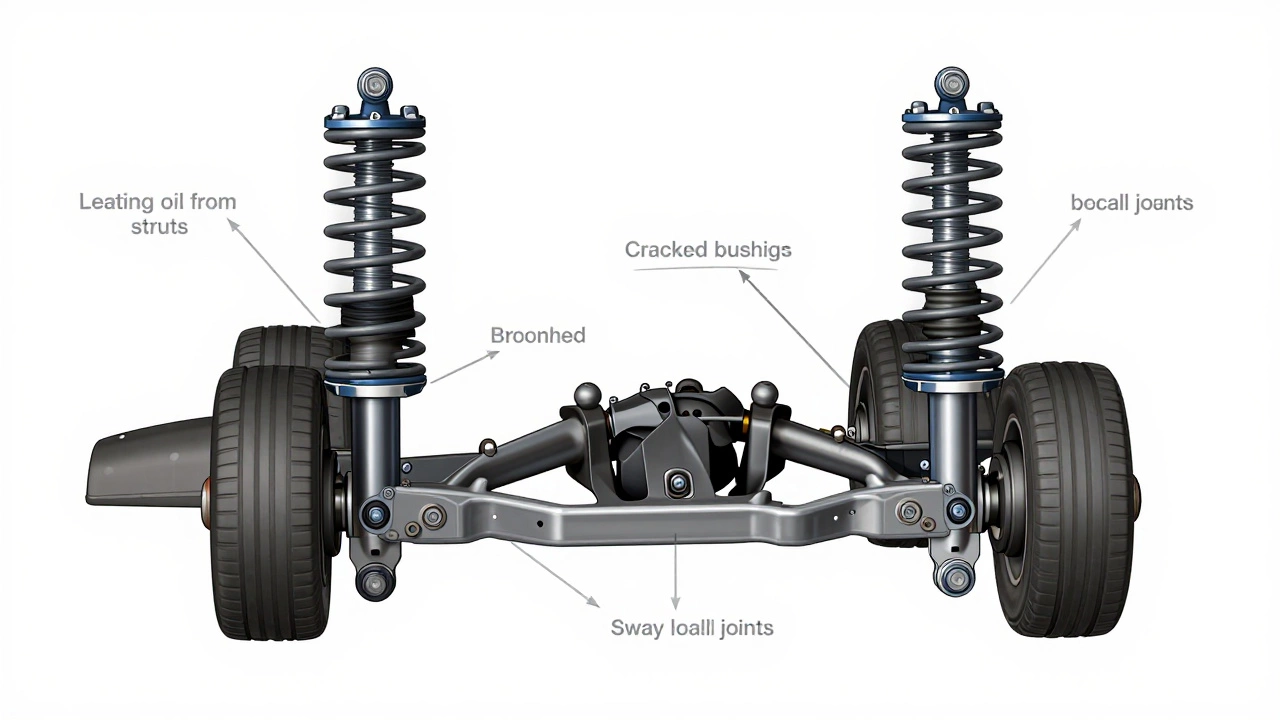
Before you start fixing anything, you need to know what you’re dealing with. Modern suspensions are made of several key components:
- Shock absorbers-dampen spring movement and control bounce
- Struts-combine a shock and spring in one unit, common on front suspensions
- Springs-coil or leaf springs that support the car’s weight
- Control arms-connect wheels to the frame and allow movement
- Ball joints-pivot points that let the wheels steer and move up/down
- Sway bars and bushings-reduce body roll and absorb vibrations
Any of these can wear out. A bad ball joint might cause clunking. Worn bushings can make steering feel vague. A broken spring will drop one corner of the car. You can’t just replace one part and call it fixed-you need to diagnose the whole system.
How to Diagnose the Problem
You can’t fix what you don’t understand. Start with a visual inspection. Jack up the car and put it on jack stands. Never work under a car supported only by a jack.
Look for:
- Oil leaking from shock absorbers or struts-this means they’re done
- Cracked or crumbling rubber bushings
- Loose or rusted control arms
- Worn ball joints with visible play-wiggle the tire top and bottom. If it moves more than 1/8 inch, replace it
- Broken or sagging springs
Do the bounce test too. Push down hard on each corner of the car and let go. If it bounces more than once or twice, the shocks or struts are worn out. New ones should stop the motion in one bounce.
Check your tires. If the tread is worn more on the inside or outside, that’s a sign of misalignment caused by bad suspension parts. You’ll need to fix the suspension before getting an alignment.
Tools You’ll Need
You don’t need a full garage, but you do need the right gear:
- Jack and jack stands (never skip the stands)
- Wheel chocks
- Socket set and torque wrench
- Spring compressor (for struts-this is critical)
- Breaker bar for stubborn bolts
- Penetrating oil (like PB Blaster)
- Protective gloves and safety glasses
If you’re replacing struts, you’ll need a spring compressor. These are dangerous if used wrong. If you’ve never used one, consider buying pre-assembled strut assemblies. They cost more but save hours and reduce risk.
Step-by-Step: Replacing Shocks and Struts
Replacing shocks is simpler than struts. Here’s how to do both.
Replacing Shocks
- Loosen the lug nuts on the wheel before jacking up the car.
- Jack up the car and secure it on jack stands. Chock the opposite wheels.
- Remove the wheel.
- Locate the shock absorber. It’s usually a cylindrical unit connected between the frame and the axle or control arm.
- Disconnect any brake lines or wiring if they’re in the way.
- Use a socket to remove the top mount bolt (inside the trunk or under the carpet) and the bottom bolt at the axle.
- Pull the old shock out. Compare it to the new one-make sure they match.
- Install the new shock. Tighten the bottom bolt first, then the top. Torque to manufacturer specs.
- Reinstall the wheel and lower the car. Torque the lug nuts in a star pattern.
Replacing Struts
Struts are trickier because they’re under spring tension. Here’s the safe way:
- Remove the wheel and disconnect the brake line if needed.
- Take off the top strut mount cover inside the trunk or under the carpet.
- Remove the nuts holding the strut to the steering knuckle.
- Use a spring compressor to slowly compress the coil spring. Do not rush this step.
- Once compressed, remove the top strut nut. Then remove the compressor and spring.
- Take the old strut assembly apart. Install the new spring onto the new strut.
- Reassemble with the compressor, then reinstall the strut into the knuckle.
- Reconnect the brake line and steering components.
- Torque all bolts to spec. Replace the top mount and cover.
Always replace struts in pairs. Even if only one side is bad, the other is close behind. Mismatched suspension leads to uneven handling.
Replacing Ball Joints and Bushings
Ball joints are often the source of clunking noises. To replace them:
- Remove the control arm bolts
- Separate the ball joint from the steering knuckle (use a pickle fork or ball joint separator)
- Press out the old joint and press in the new one with a hydraulic press
If you don’t have a press, buy a ball joint with a built-in press-in sleeve. Some aftermarket parts come with this feature.
Bushings are rubber rings that wear out over time. They’re often pressed into control arms or sway bar links. Replacing them requires removing the part and using a press. If the bushings are cracked or squished, replace them. They’re cheap, and they make a big difference in ride quality.
What to Buy: OEM vs. Aftermarket
You don’t need to buy dealer parts, but cheap knock-offs will fail fast. Look for brands like Monroe, KYB, Gabriel, or Bilstein. These are used by mechanics and have proven track records.
For struts, consider pre-assembled units like the Monroe Quick Strut a complete strut assembly with spring, mount, and bumper already installed. They cut labor time in half and reduce the chance of error.
Avoid no-name brands from Amazon or eBay. Many are made with inferior materials and fail within 10,000 miles. Stick to parts sold by reputable auto parts stores like AutoZone, Advance Auto Parts, or RockAuto.

After the Repair: Alignment and Testing
Never skip the alignment after replacing suspension parts. Even if the old parts looked fine, replacing them changes the geometry. A bad alignment will destroy new tires in weeks.
Take the car for a test drive. Go over speed bumps, potholes, and highway ramps. Listen for any new noises. Feel for steering response. If it still feels loose or bouncy, something’s still wrong.
Check your tire pressure and tread depth. If the tires are worn unevenly, they’ll need to be rotated or replaced. Driving on bad tires with a repaired suspension is like putting new brakes on a car with bald tires-it won’t save you.
How Often Should Suspension Parts Be Replaced?
There’s no fixed schedule, but most shocks and struts last between 50,000 and 100,000 miles. In the UK, where roads are rough and weather is harsh, many drivers see wear by 60,000 miles.
Check your suspension every 20,000 miles during routine service. A quick visual check takes 5 minutes and can save you hundreds later.
If you drive on gravel roads, tow trailers, or carry heavy loads often, your suspension wears faster. Consider upgrading to heavy-duty parts if you do.
When to Call a Pro
You can fix shocks and struts yourself if you’re handy. But if you’re unsure about:
- Using a spring compressor
- Removing a rusted control arm
- Aligning the wheels
Then get help. A bad job can lead to a serious accident. Mechanics charge £150-£300 per axle for strut replacement, but it’s worth it for safety.
Some shops offer free inspections. Use them. A £0 inspection can save you £800 in future repairs.
Final Tips for Long-Lasting Suspension
- Avoid potholes and curbs when you can
- Don’t overload your car beyond the manufacturer’s limit
- Check tire pressure monthly-underinflated tires stress the suspension
- Wash undercarriage in winter to prevent rust, especially on control arms and springs
- Replace worn parts in pairs, never singles
A good suspension doesn’t just make your ride smoother-it keeps you alive. Don’t wait until your car feels like a washing machine on spin cycle. Fix it now, before it fixes you.