Spark Plug Diagnostic Tool
Check for Spark Plug Issues
Answer these questions to determine if your spark plugs need replacement. Based on your symptoms and maintenance history.
Symptoms
Diagnosis Result
Recommended Action:
Cost Comparison:
Replacing spark plugs: £30-£80 | Catalytic converter repair: £800-£2,000
Your car sputters on cold mornings. It hesitates when you press the gas. The check engine light flickers on and off like a broken traffic signal. You might think it’s the fuel system, the battery, or maybe even the air filter. But more often than not, the real culprit is hiding in plain sight: your spark plugs.
What spark plugs actually do
Spark plugs are small but vital. They sit in the top of each engine cylinder and create a tiny electric spark-about 20,000 volts-that ignites the fuel and air mixture. That spark turns into a controlled explosion, pushing the piston down and making your car move. Without it, your engine doesn’t run. Simple as that.
Most modern cars have four, six, or eight spark plugs. They’re designed to last anywhere from 30,000 to 100,000 miles, depending on the type. Copper plugs wear out faster-around 30,000 miles. Platinum and iridium plugs last longer, often up to 80,000 or even 100,000 miles. But even the best ones don’t last forever. And when they start to fail, your car doesn’t just slow down-it starts talking to you.
Sign #1: Your engine misfires
One of the clearest signals you’ve got bad spark plugs is an engine misfire. That’s when one or more cylinders fail to ignite properly. You’ll feel it as a sudden jerk or stumble, especially when accelerating from a stop. It might happen once in a while, then disappear. Then it comes back, worse than before.
Modern cars will usually trigger a check engine light and store a diagnostic code like P0300 (random misfire) or P0301-P0308 (specific cylinder misfire). But you don’t need a code reader to know something’s wrong. If your car feels like it’s limping along, especially uphill or under load, spark plugs are high on the list.
Sign #2: Poor fuel economy
Bad spark plugs don’t just make your car feel sluggish-they make it waste fuel. When the spark is weak or inconsistent, not all the fuel burns completely. That means you’re paying for gas that never turns into motion.
Drivers in Bristol who’ve swapped worn spark plugs for new ones often report a 4% to 10% improvement in miles per gallon. That’s not small change. If you’re filling up every 280 miles instead of 320, and you drive 12,000 miles a year, you’re throwing away £150-£300 annually. That’s enough for a full tank every month.
Sign #3: Hard starts and rough idling
Ever turn the key and hear the engine crank for three seconds before it finally catches? That’s not normal. It’s especially bad in cold weather, but if it’s happening all year round, your spark plugs are likely struggling to jump the gap.
Same with rough idling. When the car’s at a stoplight and the engine shakes like it’s about to quit, that’s a sign of uneven firing. A healthy engine idles smooth as butter. A bad one shudders. You might even hear a rhythmic popping sound from the exhaust.
Sign #4: Sluggish acceleration
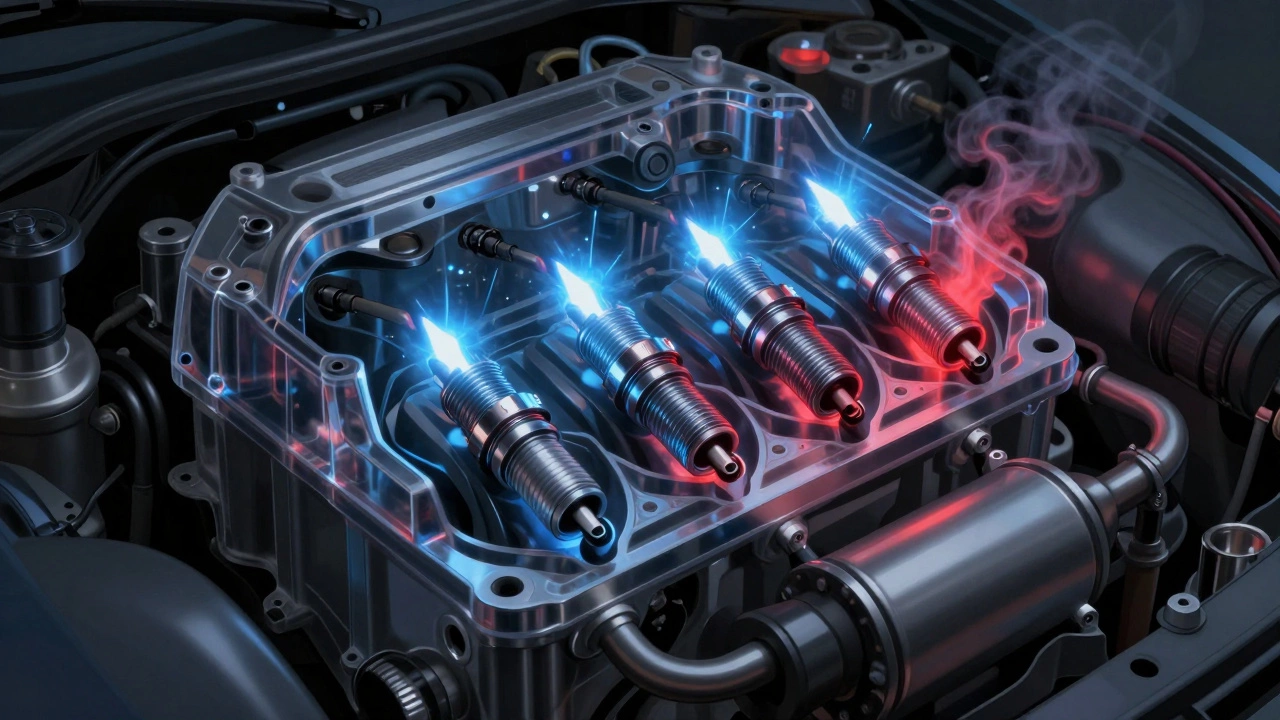
Remember when your car used to leap forward when you pressed the pedal? Now it feels like you’re driving through syrup. That’s not just old tires or low transmission fluid. It’s often weak spark plugs.
When the spark isn’t strong enough, combustion is incomplete. That means less power gets to the wheels. You’ll notice it most when merging onto the motorway or climbing a hill. The engine revs, but the car doesn’t respond like it should. It’s not the transmission-it’s the spark.
Sign #5: The check engine light is on
Yes, the check engine light can mean a hundred different things. But if it’s flashing, that’s urgent. A flashing light usually means a severe misfire-often caused by failing spark plugs. Even if it’s just steady, don’t ignore it. A simple OBD2 scanner from Amazon costs £15 and can tell you if it’s a spark plug code. No need to pay a garage just to find out.
Sign #6: You’re past the recommended mileage
Don’t wait for symptoms. If your car’s manual says to replace spark plugs at 60,000 miles and you’re at 75,000? You’re overdue. Even if the car feels fine, the plugs are wearing down. The electrode gap widens over time. The insulator cracks. The ceramic breaks. You’re running on borrowed time.
Some people think, “It’s still running, so why replace it?” But that’s like waiting for your brakes to fail before checking them. Spark plugs degrade slowly. By the time you notice the problem, you’re already damaging other parts-like the catalytic converter. Replacing them early saves you hundreds in repairs later.
What happens if you ignore bad spark plugs?
Ignoring worn spark plugs doesn’t just make your car feel bad-it can wreck expensive parts. A misfire sends unburned fuel into the exhaust. That fuel overheats the catalytic converter, which can melt from the inside. Replacing a catalytic converter costs between £800 and £2,000. Spark plugs? £30 to £80 for a full set.
Also, incomplete combustion leaves carbon deposits on valves and pistons. Over time, that buildup reduces compression and hurts performance. You might end up needing a valve job or engine cleaning-both far more expensive than a simple plug change.

How to check spark plugs yourself
You don’t need to be a mechanic to check them. Here’s how:
- Turn off the engine and let it cool. Hot engines can burn you.
- Remove the ignition coil or spark plug wire from one plug.
- Use a spark plug socket and ratchet to unscrew the plug.
- Look at the electrode. A healthy plug has a light brown or grayish color. Black, oily deposits mean too much fuel. White or blistered tips mean overheating. Cracked ceramic? Replace it.
- Check the gap. Use a feeler gauge. If it’s wider than the manufacturer’s spec (usually 0.6-1.1mm), it’s worn.
If even one plug looks bad, replace the whole set. They all wear at the same rate. Mixing old and new plugs causes uneven firing.
When to replace spark plugs
Follow your owner’s manual. But here’s a general guide:
- Copper plugs: Replace every 30,000 miles
- Platinum plugs: Replace every 60,000-80,000 miles
- Iridium plugs: Replace every 80,000-100,000 miles
If you drive mostly short trips in city traffic, replace them 10,000 miles earlier. Short trips don’t let the engine reach full temperature, so carbon builds up faster.
And if you live in a damp place like Bristol? Moisture gets into the plug wells. That can cause corrosion or misfires. Check them every 2 years, even if you haven’t hit the mileage.
What to buy
Don’t buy the cheapest plugs you can find. They’re often knock-offs with poor materials. Stick to brands like NGK, Denso, Bosch, or Champion. Match the exact part number for your car. You can find it in your manual or online using your VIN.
Don’t upgrade to a “performance” plug unless your car’s tuned for it. Stock engines are designed for specific heat ranges. Wrong plugs can overheat or foul faster.
Final thought: Don’t wait for disaster
Spark plugs are cheap. Replacing them is simple. And the payoff is immediate: smoother starts, better fuel economy, and fewer surprises on the road. If your car’s acting up and you haven’t checked the plugs in the last 40,000 miles, it’s time. Don’t wait for the check engine light to scream. Listen to the quiet signs-the hesitation, the shudder, the extra trips to the pump. Your engine is telling you what it needs.
How often should I replace my spark plugs?
It depends on the type. Copper plugs last 30,000 miles, platinum plugs 60,000-80,000 miles, and iridium plugs 80,000-100,000 miles. Always check your owner’s manual. If you drive mostly short trips or in wet weather, replace them 10,000 miles earlier.
Can bad spark plugs damage my engine?
Yes. Misfires from worn spark plugs send unburned fuel into the exhaust, which can overheat and melt the catalytic converter. That repair costs £800-£2,000. Carbon buildup on valves and pistons can also reduce engine efficiency over time. Replacing plugs early prevents these expensive problems.
Can I drive with a bad spark plug?
You can, but you shouldn’t. Driving with a misfiring cylinder for too long risks damaging the catalytic converter and increasing emissions. You’ll also get worse fuel economy and possible engine damage. If you notice symptoms like rough idling or hesitation, get it fixed within a week.
Why does my car shake at idle?
A shaking idle usually means one or more cylinders aren’t firing properly. Bad spark plugs are the most common cause. Other possibilities include a vacuum leak or dirty fuel injectors, but spark plugs are the easiest and cheapest thing to check first.
Do I need to replace all spark plugs at once?
Yes. Even if only one looks bad, the others are just as worn. Mixing old and new plugs causes uneven firing, which hurts performance and can damage the ignition system. Always replace them as a full set.