Oil Change Estimator
How overdue is your oil?
This tool estimates when your oil change is due based on your driving habits and current conditions. Enter your information to see if you're at risk.
Results
Recommended Interval:
Skipping your oil change isn’t just a minor oversight-it’s like letting your car run on dirty water instead of fuel. You might think, "It’s only a few weeks late," or "The car still drives fine." But engines don’t lie. When oil breaks down or gets thick with grime, it stops doing its job. And when that happens, the damage doesn’t wait for a warning light.
What Engine Oil Actually Does
Engine oil isn’t just a lubricant. It’s your engine’s life support system. It cools hot parts, cleans away metal shavings and carbon deposits, seals gaps between pistons and cylinders, and prevents rust. Modern synthetic oils last longer than old mineral oils, but they still degrade. Heat, pressure, and contamination eat away at their protective qualities over time.
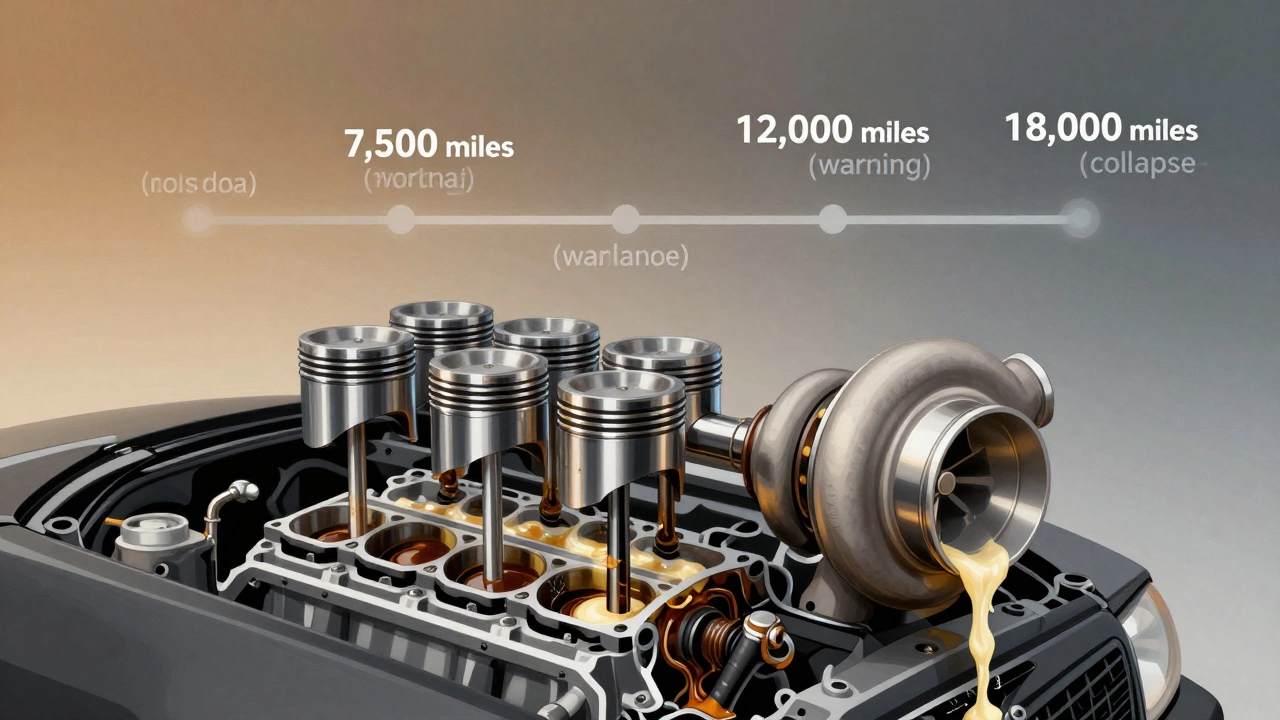
Most manufacturers recommend an oil change every 7,500 to 10,000 miles, or once a year-whichever comes first. But if you’re driving in stop-and-go traffic, towing, or in extreme heat or cold, that clock ticks faster. And if you’ve gone past 12,000 miles without a change? You’re already in risky territory.
What Happens When Oil Gets Too Old
Old oil doesn’t just get dirty-it turns into something dangerous.
- Thick, sludgy oil doesn’t flow well. It pools in the bottom of the engine instead of reaching critical parts like valve lifters and camshafts.
- Loss of lubrication means metal parts start grinding. You won’t hear it at first, but the wear adds up. Bearings, pistons, and cylinder walls slowly scar.
- Overheating becomes more likely. Oil helps carry heat away from the combustion chamber. When it’s degraded, that heat stays trapped, stressing components that weren’t designed to run hot.
- Increased friction saps power. Your car feels sluggish. Fuel economy drops. You might notice it’s harder to accelerate or the engine sounds louder.
- Carbon buildup clogs oil passages. This is especially bad in turbocharged engines. A clogged oil line can kill a turbo in minutes.
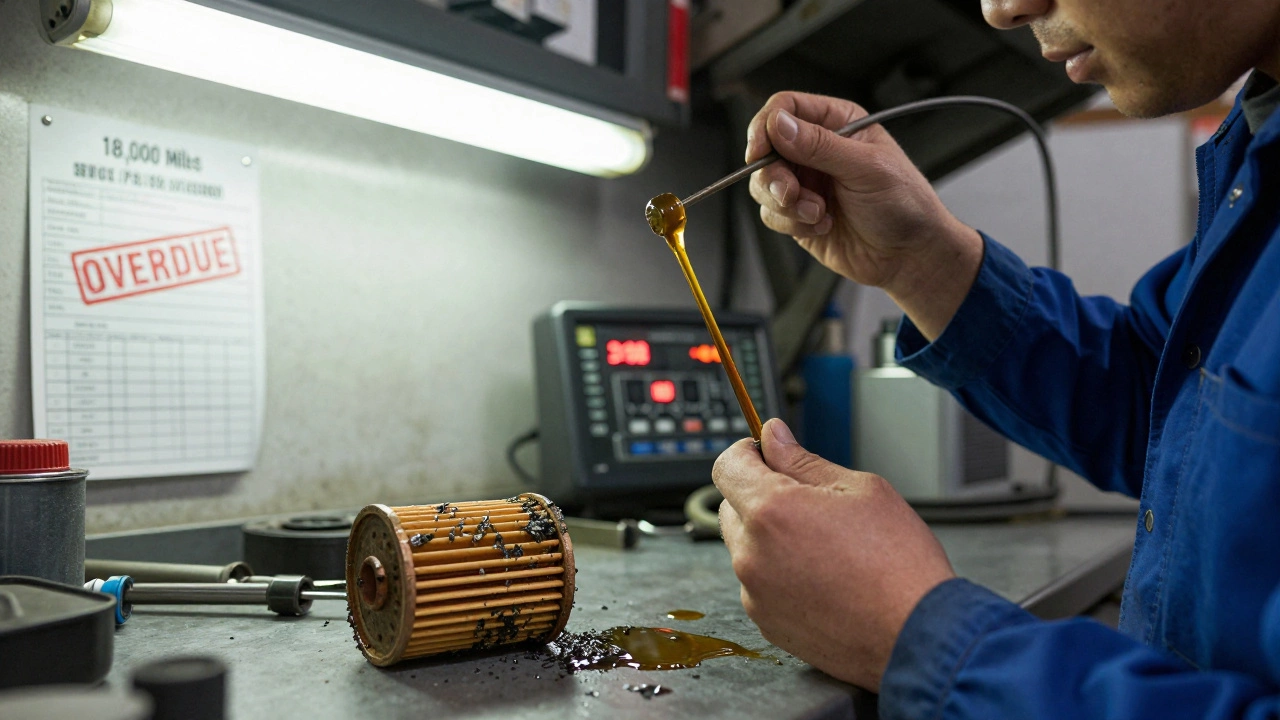
One mechanic in Bristol told me about a 2020 Honda Civic that had 18,000 miles on its original oil. The owner swore it ran fine. When they opened it up, the oil pan was full of black sludge. The timing chain tensioner had seized. Repair cost: £2,300. A simple oil change would’ve cost £60.
How Long Is Too Long?
There’s no magic number. But here’s a rough guide based on real-world conditions:
| Driving Condition | Max Safe Interval | Risk Level |
|---|---|---|
| Highway driving, mild climate | 12,000 miles or 12 months | Moderate |
| Stop-and-go traffic, short trips | 7,500 miles or 6 months | High |
| Towing, hauling, extreme heat/cold | 5,000 miles or 4 months | Very High |
| Over 15,000 miles or 18+ months | Do not drive | Extreme |
Many people don’t realize that short trips are worse than long ones. If you drive less than 5 miles at a time, the engine never warms up enough to burn off moisture. That moisture mixes with oil and turns into acid. Acid eats bearings. Acid ruins seals. And once that starts, no amount of fresh oil will undo it.
Signs You’re Already in Trouble
You don’t need a diagnostic tool to know something’s wrong. Here’s what to look for:
- Engine noise-especially a ticking or knocking sound from the top of the engine
- Oil that looks like tar or has visible metal flakes when you check the dipstick
- Low oil pressure warning light (even if it comes on briefly)
- Exhaust smoke that’s thicker than usual, especially blue smoke
- A sudden drop in fuel economy
- Engine overheating, even with coolant levels normal
If you see any of these, don’t wait for your next service. Get the oil changed immediately. And if you’ve gone more than 15,000 miles or 18 months? Get the engine inspected before driving it anywhere.
What Happens If You Ignore It
Ignoring overdue oil changes doesn’t lead to a slow decline. It leads to sudden, expensive failure.
One common outcome: engine seizure. When oil stops flowing, pistons stick. The engine locks up. You hear a loud bang. The car dies. And you’re looking at a £3,000 to £7,000 engine replacement. Most insurance won’t cover it-it’s considered neglect.
Another: blown head gasket. Old oil can’t cool the engine properly. Heat warps the cylinder head. Coolant leaks into the oil. The mixture turns into a milky sludge. That’s a head gasket job-£1,500 minimum.
And then there’s turbo failure. Turbos spin at over 100,000 RPM. They need clean, flowing oil. If the oil is thick or clogged, the turbo bearing melts. Replacement cost? £1,800 to £3,000.
None of these are guaranteed. But the longer you wait, the higher the odds. And once it happens? You’re not just paying for repairs-you’re paying for downtime, rental cars, and lost time.
What Should You Do Now?
If you’re overdue:
- Check your oil level and color. If it’s dark brown or black, and gritty, change it now.
- Don’t drive long distances or at high speeds until the oil is fresh.
- Use the oil type your manual recommends. Synthetic is best if you’ve waited.
- Replace the oil filter. Old filters hold contaminants that will ruin new oil.
- After the change, monitor the engine for strange noises or warning lights for the next 500 miles.
And if you’re not sure when you last changed it? Look at your service records. If you can’t find them, assume it’s overdue. Better to be safe than sorry.
Myth Busting
Some people swear by "oil life monitors." They’re helpful-but not perfect. They track mileage and driving patterns, but they don’t measure actual oil quality. If you drive in dusty conditions or haul heavy loads, the oil degrades faster than the monitor thinks.
Others think "full synthetic lasts forever." It doesn’t. Synthetic oils last longer than conventional ones, but they still break down. A 10,000-mile interval is a guideline-not a guarantee.
And no, adding oil on top of old oil doesn’t fix anything. It just dilutes the sludge. You’re not renewing the oil-you’re just making more of it.
Final Reality Check
An oil change costs £50 to £100, depending on your car and where you go. Engine replacement? £3,000 to £8,000. That’s not a gamble-it’s a choice.
Think about it this way: if you skip one oil change a year, you’re gambling £3,000+ every time. And the odds get worse the longer you wait. In Bristol, where winters are damp and roads are salted, engines face extra stress. Moisture and grime combine fast. You can’t afford to cut corners.
Don’t wait for the engine to scream. Don’t wait for the warning light. Don’t wait until you’re stranded on the M4. Change the oil on time. It’s the cheapest, smartest thing you’ll ever do for your car.
Can I just add oil instead of changing it?
No. Adding oil to old, dirty oil doesn’t clean the engine. It just mixes fresh oil with sludge, which reduces its effectiveness. The contaminants stay in the system and continue to damage parts. You need a full drain and filter replacement to remove the built-up gunk.
Is it okay to go 1,000 miles over my oil change interval?
A few hundred miles over won’t hurt most modern engines, especially if you’re using synthetic oil. But 1,000 miles past the recommended interval starts to push the limits. If you’ve gone 1,000 miles over and your car shows signs of sludge or noise, get it changed immediately. Don’t make it a habit.
Do I need to change the oil every 6 months if I don’t drive much?
Yes. Even if you drive only 2,000 miles a year, oil breaks down over time. Moisture builds up from short trips. Additives wear out. Heat cycles age the oil. Most manufacturers recommend changing oil at least once a year, regardless of mileage. For cars that sit for long periods, twice a year is better.
What happens if I use the wrong oil type?
Using oil with the wrong viscosity (like 5W-30 instead of 0W-20) can cause poor lubrication, especially in cold weather. It can also affect fuel economy and emissions. In turbocharged engines, it can lead to oil starvation and turbo failure. Always follow your owner’s manual. If you’re unsure, check the oil cap-it often lists the correct grade.
Can an overdue oil change void my warranty?
Yes-if the engine failure is directly linked to neglected maintenance. Manufacturers require proof of regular oil changes to honor engine-related warranty claims. If you skip changes and your engine seizes, the dealer can deny the claim. Keep receipts or digital records. It’s your proof of care.
If you’ve been putting off your oil change, the best time to do it was yesterday. The second-best time is now. Your engine will thank you.