Spark Plug Replacement Cost Calculator
Calculate Your Potential Savings
See how much you could save by replacing spark plugs on schedule versus the cost of engine damage from neglect.
Based on your information, your engine may be at risk of damage to the exhaust system and internal engine components. This could lead to expensive repairs that cost -- dollars.
Ever heard someone say, "I just ignored my spark plugs for a year, and my car still ran"? That’s not luck-it’s a gamble. And like any gamble, the house always wins eventually. Bad spark plugs don’t just make your car run poorly. Left unchecked, they can wreck your engine-costing you thousands in repairs you could’ve avoided with a $50 part and 30 minutes of your time.
What Spark Plugs Actually Do
Spark plugs aren’t just little metal sticks in your engine. They’re the ignition system’s heartbeat. Every time your engine fires, a spark plug sends a 20,000-volt electrical pulse across a tiny gap, igniting the air-fuel mixture in the cylinder. That tiny explosion pushes the piston down, turns the crankshaft, and moves your car forward. Simple? Yes. Critical? Absolutely.
Modern spark plugs are designed to last 60,000 to 100,000 miles, depending on the material. Copper plugs wear out faster. Platinum and iridium ones last longer. But even the best ones don’t last forever. When they start to fail, they don’t just stop working-they start causing damage.
How Bad Spark Plugs Start to Hurt Your Engine
It starts small. You notice the engine hesitates when you step on the gas. Maybe it misfires on cold mornings. You chalk it up to "old car stuff." But here’s what’s really happening under the hood:
- Weak or no spark: Carbon buildup, cracked porcelain, or worn electrodes mean the spark can’t jump the gap. Fuel doesn’t ignite properly.
- Unburned fuel: When fuel doesn’t ignite, it gets pushed out of the cylinder and into the exhaust system. That’s raw gasoline flooding your catalytic converter.
- Overheating: If fuel doesn’t burn cleanly, it creates hot spots inside the combustion chamber. This can warp or crack pistons and valves.
- Oil contamination: Failing spark plugs cause misfires that throw off the engine’s air-fuel ratio. That can lead to excess oil burning and carbon buildup on the plugs-creating a vicious cycle.
These aren’t theoretical problems. I’ve seen a 2018 Honda Civic come in with a blown catalytic converter because the owner thought "if it’s still running, it’s fine." The spark plugs had been cracked for 40,000 miles. Replacing the converter cost $1,200. The plugs? $18.
Can Bad Spark Plugs Really Destroy Your Engine?
Yes. And here’s how:
1. Catalytic converter meltdown
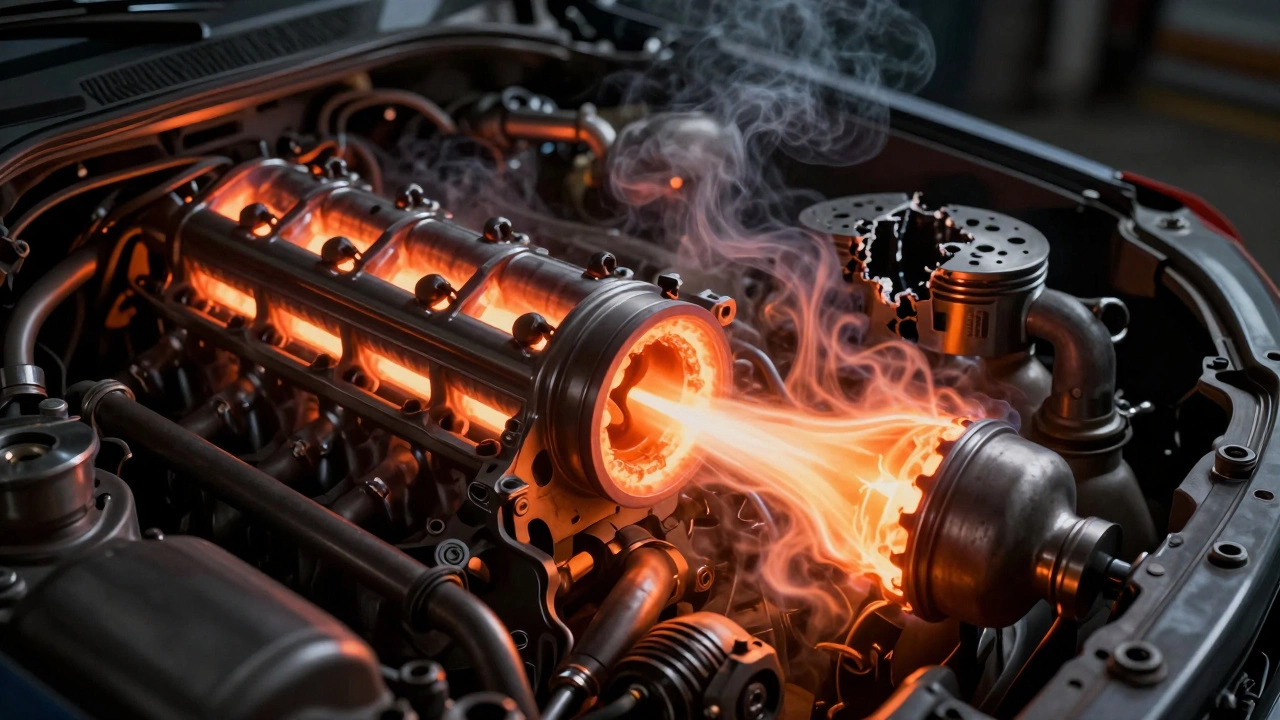
Your catalytic converter turns toxic exhaust gases into harmless ones. It does this by burning off unburned fuel that leaks out of misfiring cylinders. When too much raw fuel hits it-like from worn spark plugs-it overheats. The ceramic honeycomb inside melts, clogging the exhaust. That’s not just expensive to replace-it can cause your engine to stall or overheat from backpressure.
2. Piston and valve damage
When fuel doesn’t ignite at the right time, combustion becomes erratic. That creates pressure spikes and heat pockets inside the cylinder. Over time, this can warp aluminum pistons or burn the edges of exhaust valves. Once that happens, you’re looking at a head job-removing the cylinder head, replacing valves, machining surfaces. That’s $2,000 to $4,000 easily.
3. Engine knocking and detonation
Bad spark plugs can cause pre-ignition-where fuel ignites before the spark even fires. This creates violent, uncontrolled explosions inside the cylinder. It sounds like marbles rattling in a tin can. That’s engine knocking. If it lasts long enough, it cracks pistons, breaks rings, and can even destroy the connecting rods. That’s a total engine rebuild-or a new engine.
These aren’t rare outcomes. A 2023 study by the Automotive Aftermarket Industry Association found that 17% of engine failures traced to ignition system neglect were directly linked to worn spark plugs. Most of those vehicles had over 100,000 miles but hadn’t had plugs replaced since 60,000.
Signs Your Spark Plugs Are Failing
You don’t need a diagnostic tool to spot trouble. Here’s what to look for:
- Engine misfires or jerks when accelerating
- Slower acceleration or poor fuel economy (you’re filling up more often)
- Hard starting, especially in cold weather
- Rough idle-engine shakes when stopped
- Check engine light with codes like P0300 (random misfire) or P0301-P0308 (cylinder-specific misfires)
If you’re getting two or more of these, don’t wait. Even if the car "seems okay," you’re silently damaging parts you can’t see.
What Happens If You Ignore It?
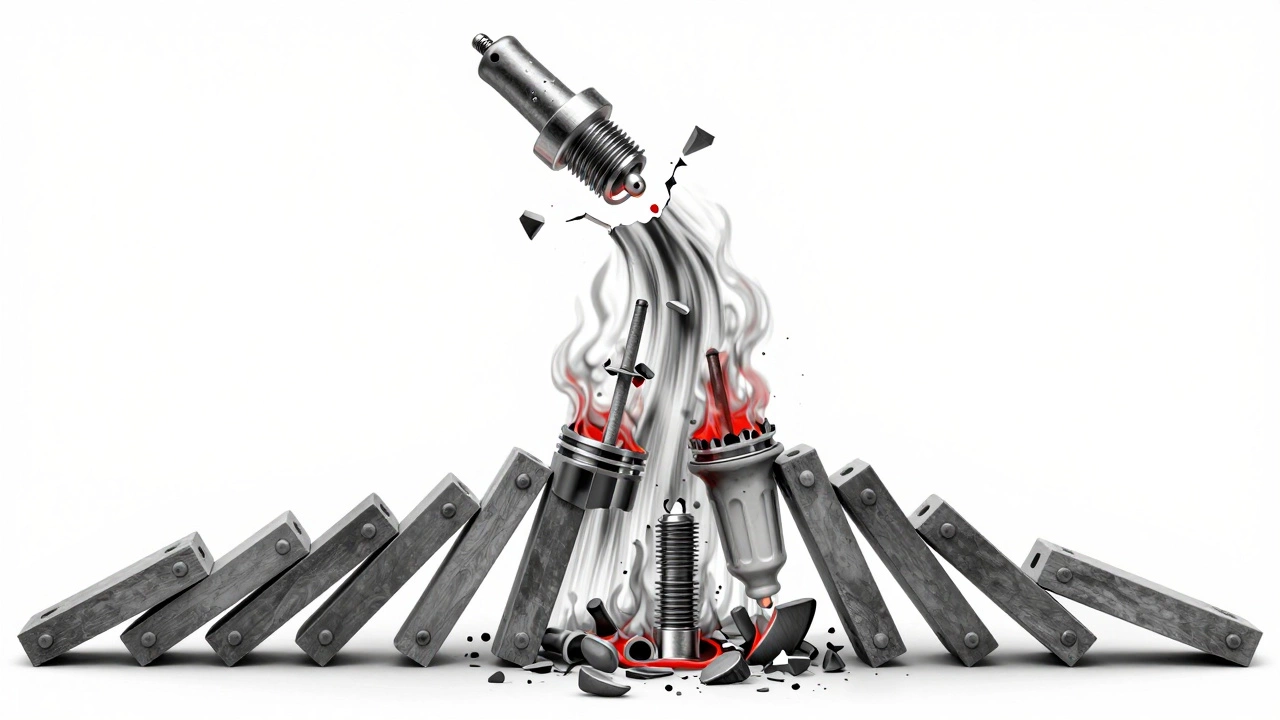
Imagine your spark plugs are like a worn-out lightbulb in a car’s headlight. You drive for weeks with dim light. You don’t crash right away. But eventually, you miss a stop sign because you can’t see it. That’s what happens with spark plugs. You don’t get a sudden explosion. You get a slow, silent cascade of damage.
By the time your car won’t start or the check engine light flashes red, you’re already past the point of simple fixes. The catalytic converter is dead. The valves are warped. The pistons are cracked. You’re not just replacing spark plugs anymore. You’re replacing half the engine.
And here’s the kicker: most people don’t realize this. They think, "I’ll wait until it fails completely." But engines don’t fail suddenly-they fail progressively. And by the time you notice, it’s too late.
How to Prevent This
It’s simple:
- Check your owner’s manual. It says when to replace spark plugs. Don’t guess. Follow it.
- Replace them at the recommended interval-even if the car feels fine.
- Use the right type. Iridium for performance, platinum for longevity, copper for budget builds. Don’t swap brands randomly.
- Have a mechanic inspect them during oil changes. A quick look at the plug’s tip tells you everything: black soot? Oil? White? Cracked? All bad signs.
- Don’t wait for the check engine light. That’s your last warning, not your first.
Most modern cars need spark plug replacement between 60,000 and 100,000 miles. But if you drive short trips, stop-and-go traffic, or in dusty areas, replace them at the lower end of that range. Every 50,000 miles is a safe bet for city drivers.
Real Cost Comparison
Let’s say you drive a 2019 Toyota Camry. Here’s what replacing spark plugs costs versus ignoring them:
| Scenario | Cost | Repair Time |
|---|---|---|
| Replace spark plugs (4-cylinder) | $120-$200 | 1-2 hours |
| Catalytic converter replacement | $900-$1,500 | 3-5 hours |
| Valve job (warped valves) | $1,800-$3,000 | 1-2 days |
| Engine rebuild (pistons, rods, crank) | $3,500-$6,000+ | 1-2 weeks |
That’s not even counting rental car costs, lost work time, or the stress of being stranded. One $150 job prevents a $5,000 disaster.
Final Thought
Spark plugs are the smallest, cheapest part in your engine. But they’re also one of the most important. They don’t just spark-they protect. Ignore them, and you’re not saving money. You’re just delaying the inevitable.
Don’t wait for smoke. Don’t wait for the check engine light. Don’t wait until your car won’t start. Replace your spark plugs on schedule. Your engine will thank you-with years of smooth, reliable runs.
Can bad spark plugs cause a car not to start?
Yes. If multiple spark plugs are completely failed, the engine won’t have enough combustion to turn over. You might hear the starter spinning, but the engine won’t catch. This usually happens after prolonged neglect-when the plugs are coated in carbon, cracked, or so badly worn they can’t spark at all.
Do I need to replace all spark plugs at once?
Always. Even if only one plug looks bad, the others are just as old. Mixing old and new plugs creates uneven performance and can strain your ignition coils. Replacing them as a full set ensures consistent spark across all cylinders and prevents future misfires.
Can I drive with a bad spark plug for a few days?
You can, but you shouldn’t. Driving even a few days with a misfiring cylinder can flood the catalytic converter with raw fuel. That’s enough to start permanent damage. If you must drive, keep speeds low, avoid hard acceleration, and get it fixed as soon as possible.
Do expensive spark plugs last longer?
Yes. Iridium and platinum plugs last 2-3 times longer than copper ones. A copper plug might need replacing at 30,000 miles, while an iridium plug can go 100,000. But they’re not always necessary. Check your owner’s manual-some engines are designed for specific plug types. Using the wrong one can hurt performance.
Can bad spark plugs affect gas mileage?
Absolutely. Misfiring cylinders mean unburned fuel is wasted. Studies show that worn spark plugs can reduce fuel economy by up to 30%. That’s like paying an extra $1.50 per gallon. Over a year, that adds up to hundreds of dollars.